
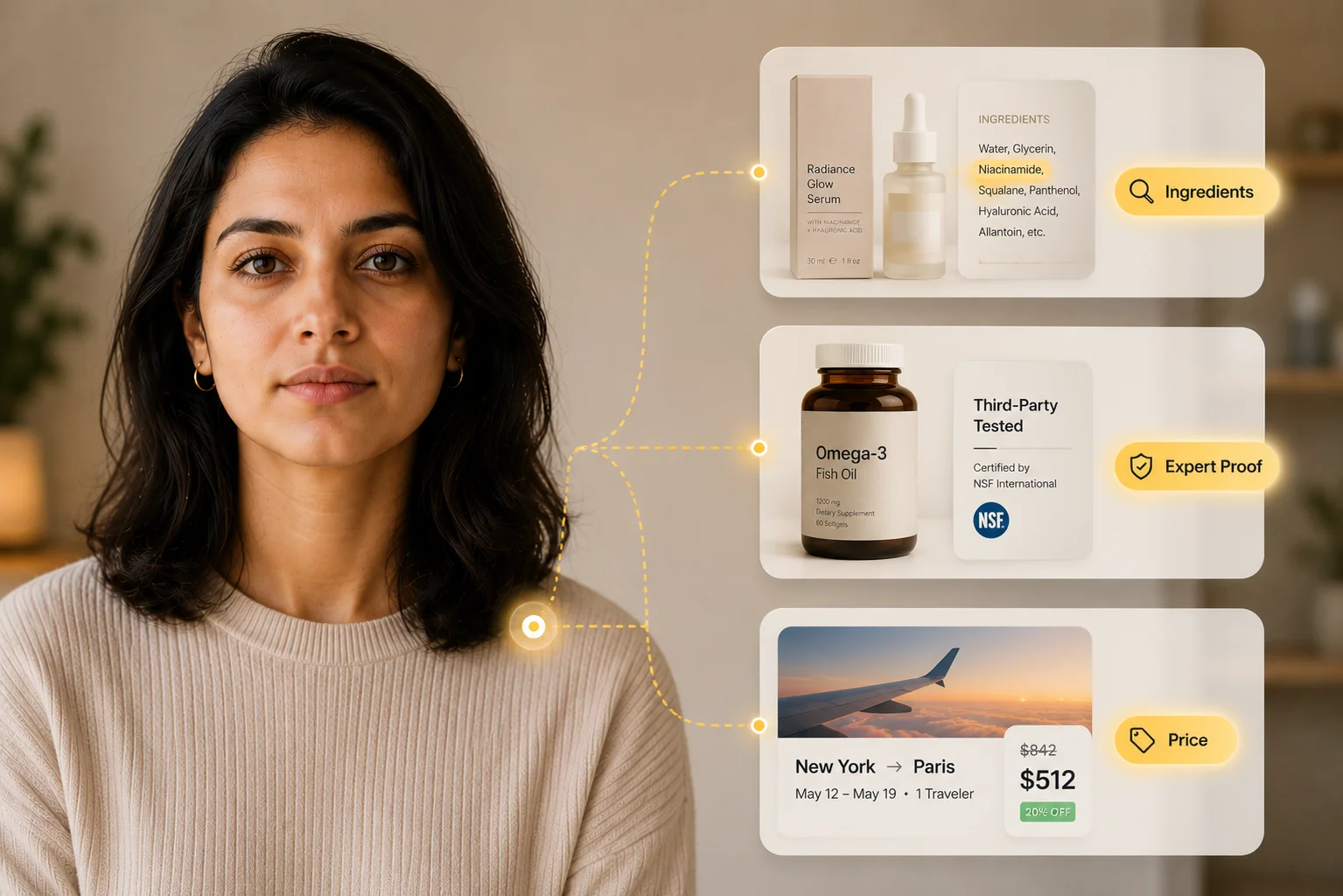
Personas that predict behaviour — in the category you actually sell in.
Most brands run one persona project every few years and reuse the deck across every category. That's why your skincare persona doesn't predict her supplement-buying behaviour. Alchemic runs persona discovery as a focused qualitative project — fast, AI-moderated, category-specific.
Trusted by brand and insights teams at








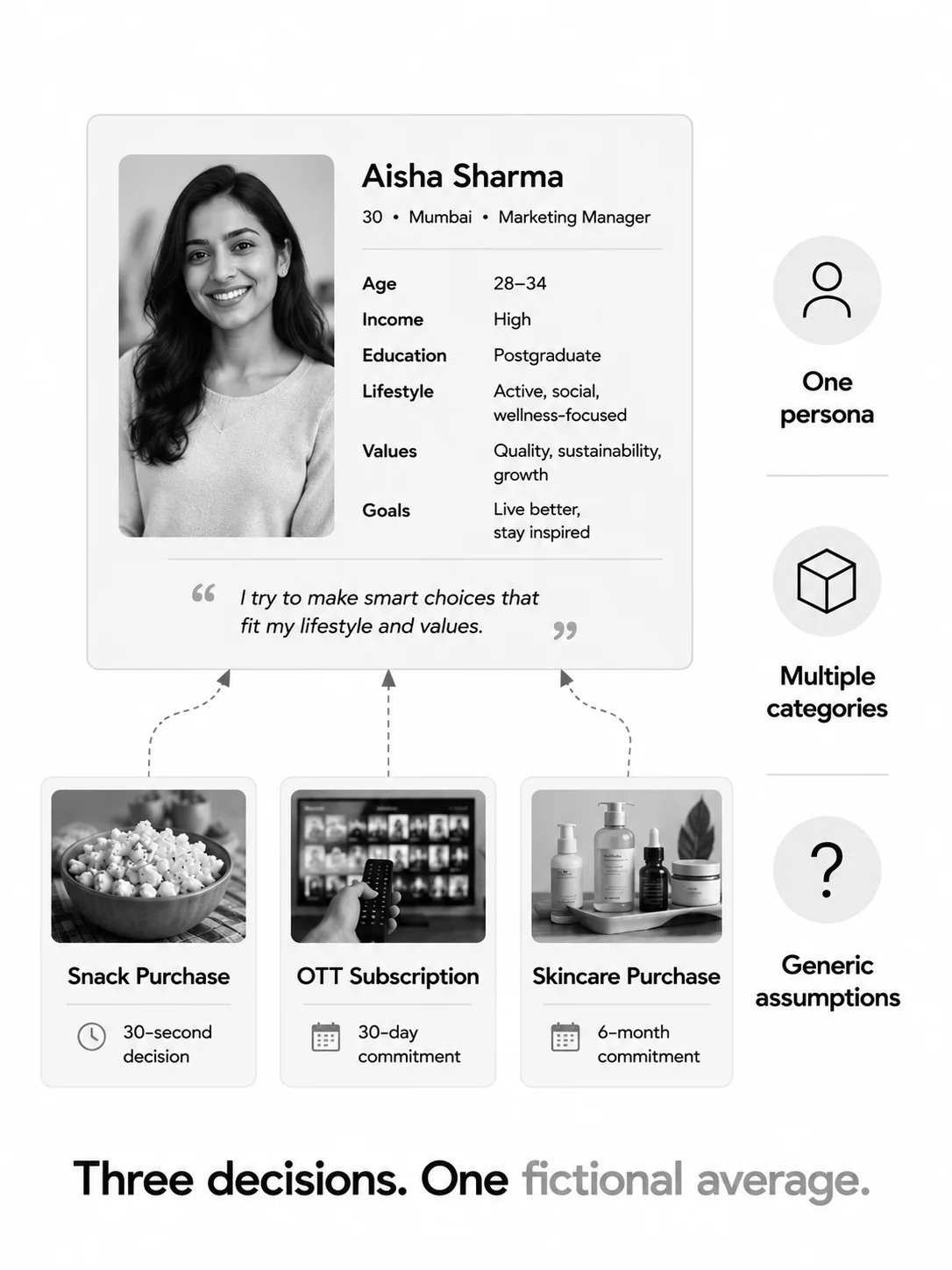
A persona built once, used everywhere, predicts nothing in particular.
Most companies have a persona deck. It was built three years ago in a workshop, or by a consultancy on a 12-week engagement, and it lives in a Google Drive that brand managers pull from when they need a slide. It describes a “Conscious Urban Millennial” or a “Value-Seeking Tier 2 Mom” in generic terms — age, income, attitudes, a stock photo.
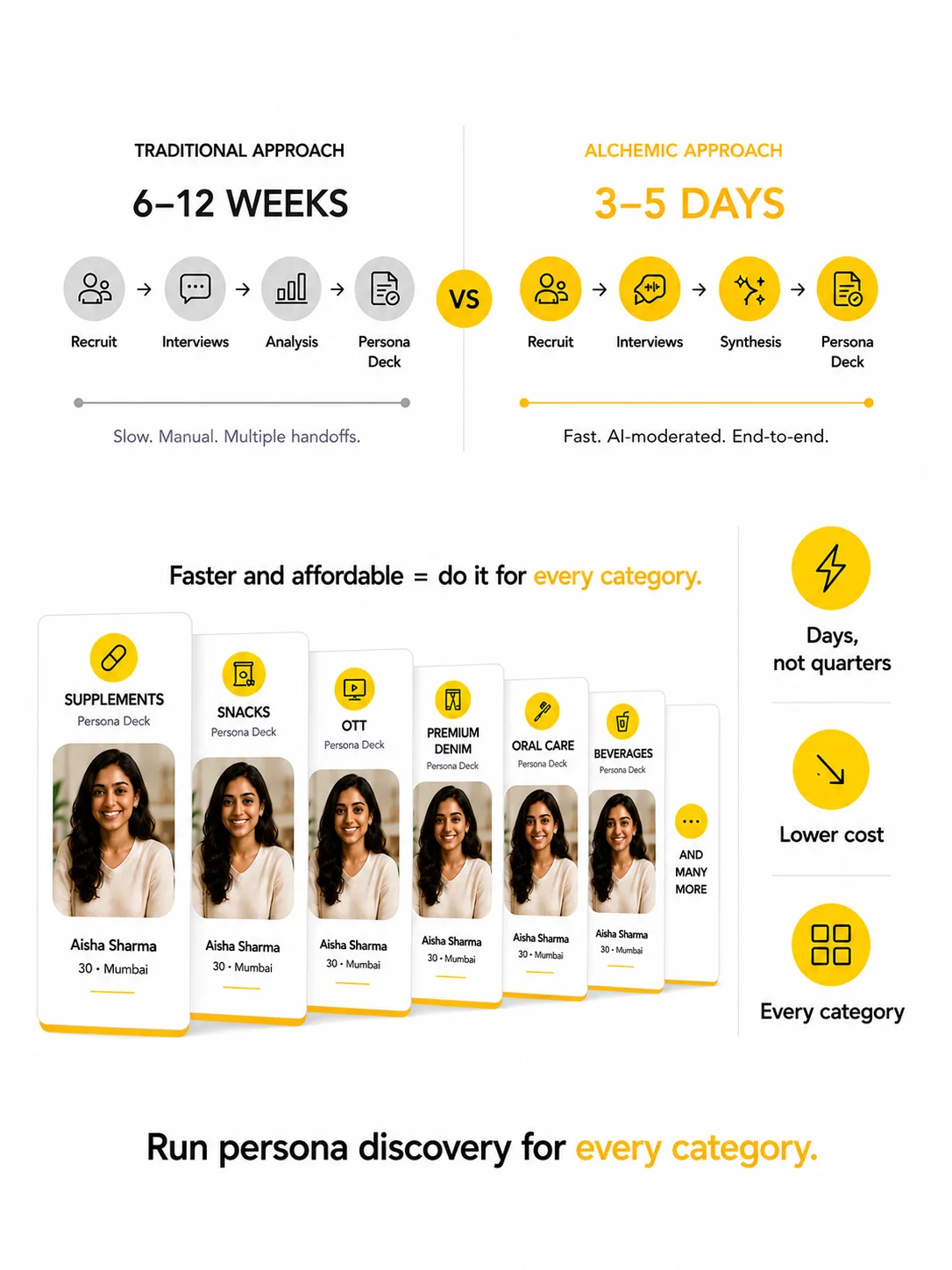
The problem isn't that the persona is wrong. It's that it was built for one category and is being reused across all of them. The same customer makes a 30-second snack decision very differently from a 30-day OTT subscription decision, and very differently again from a six-month skincare commitment. Reusing one persona collapses three real customers into one fictional average — and you brief creative against that average.
The deeper issue is cost. Doing persona work properly used to mean a six-week field study, a strategy partner, and a budget that only the launch of a flagship brand could justify. So teams ran one project, every few years, and stretched the output across the portfolio.
Three things that make it work.
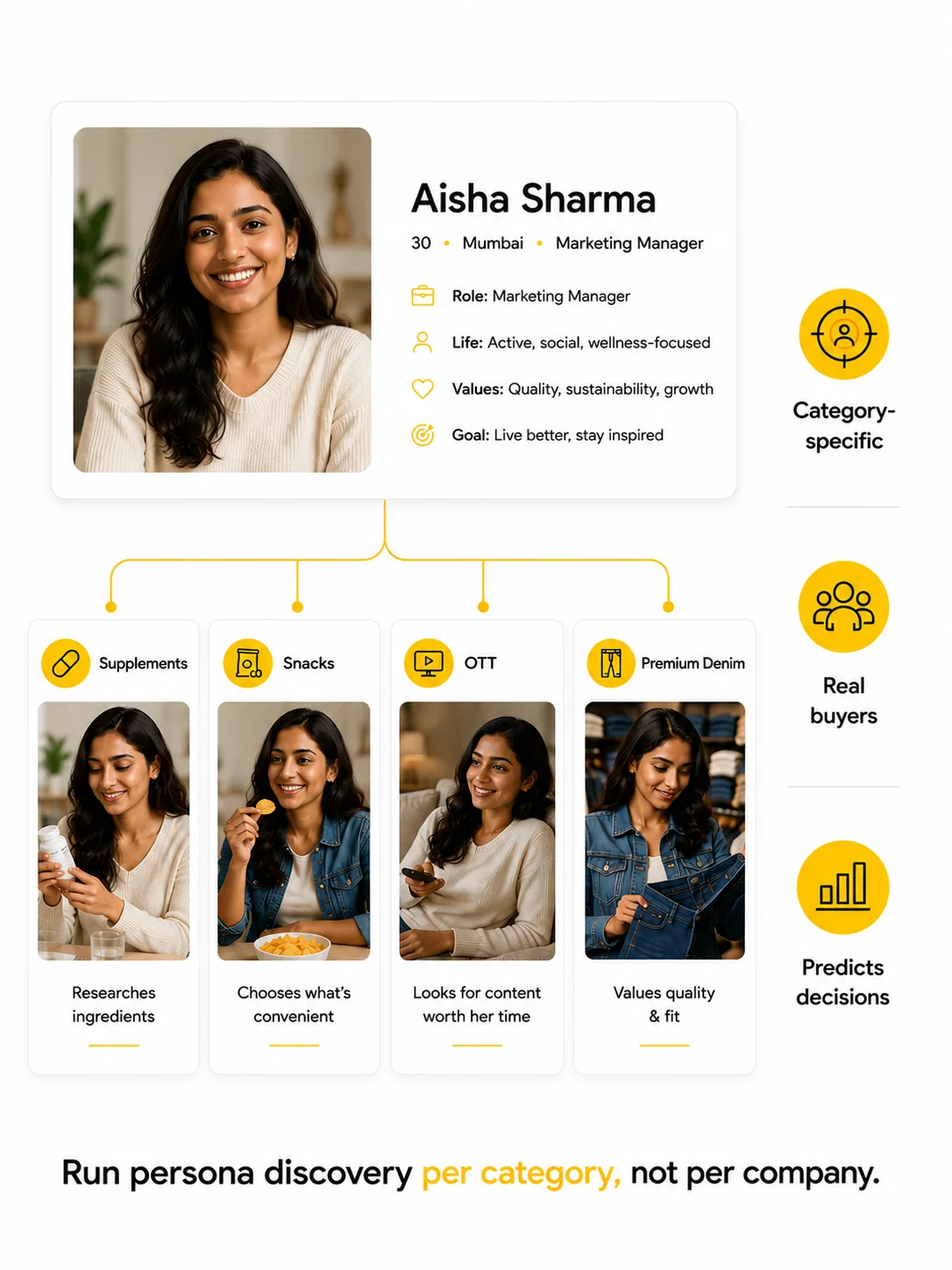
Run persona discovery per category, not per company.
Spin up a focused qualitative study for the specific category you're working in — supplements, snacks, OTT, premium denim, whatever the brief is. Alchemic conducts AI-moderated interviews with category buyers on WhatsApp, web, or phone, in the languages they actually speak. You get personas built from people making decisions in that category, not extrapolated from a generic mom archetype.
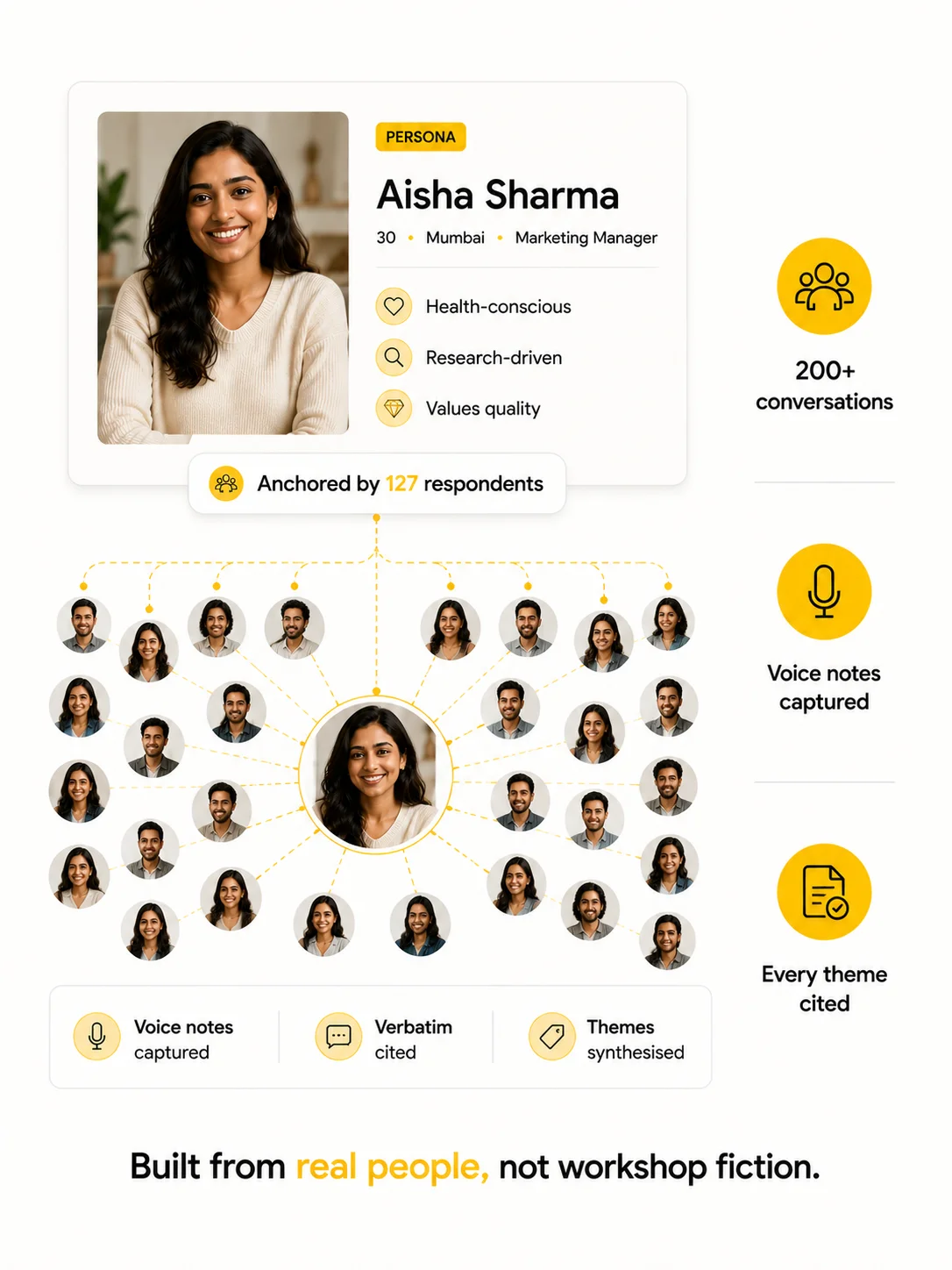
Talk to enough real people that the patterns are stable.
Workshop-built personas describe two or three made-up people. Alchemic-built personas come out of 60, 100, 200 real conversations — enough that the clusters are statistically and qualitatively stable. The AI moderator probes the “why” behind every answer, captures voice notes, and synthesises themes with every verbatim cited. You see the actual respondents who anchor each persona, not just the slide.
Get to a usable persona deck in days, not quarters.
A traditional persona engagement runs six to twelve weeks. Alchemic compresses that into days — recruit, field, transcribe, synthesise, write up. The cost drops by a similar order of magnitude. That's the unlock — when persona discovery costs what a creative concept review costs, you run it for every category, not just the flagship launch.
From brief to persona clusters in three steps.
Step 1
Scope the category.
Tell us the category, the decision occasion, and the customer universe. We help you draft the discussion guide — buying triggers, alternatives considered, emotional jobs, deal-breakers. The AI moderator gets briefed on your category vocabulary and prior research.
Step 2
Field on WhatsApp, web, or phone.
The AI moderator conducts open-ended conversations with category buyers on their channel of choice. It probes follow-ups, picks up voice notes, asks for context. Field 60 to 300 interviews in parallel — not in series.
Step 3
Watch the personas emerge live.
Themes, clusters, and persona archetypes assemble in the dashboard as responses come in. Every persona is built from cited verbatims and the actual respondents inside it. Export to a working deck or read it live.
[ why alchemic ]
What makes this different.
Built for one category at a time.
Other persona tools push you toward one universal segmentation. Alchemic is designed for category-specific persona projects — the deck you produce for shampoo doesn't have to do double duty for chocolate. That's the point.
Category-vocabulary AI.
The AI moderator is trained on your category's language before fielding. It knows the difference between "shine," "frizz," and "fall" in haircare, or "absorption" and "post-workout" in supplements. The probing is sharper because the vocabulary is right.
Multi-channel field, India-aware.
WhatsApp, web, or phone. Hindi, Tamil, Telugu, Marathi, English — and 30+ others. Voice-first respondents stay voice-first. You reach the actual customer base of the category, not just the English-typing urban tier of it.
Verbatims, not just archetypes.
Every persona is anchored to the real conversations that built it. Click into any trait and read the cited quote, listen to the voice note, see the respondent ID. No more "where did this insight come from" arguments in the deck review.
[ use cases ]
What brands discover.
Brand launch in a new category
Build a persona deck specific to the category before you write the first creative brief.
“What does the early adopter of premium protein bars in Tier 1 India actually look like?”
Repositioning an existing brand
Rebuild personas for the category the brand competes in today, not the one it was launched for.
“Who are we losing to D2C in our core mid-priced skincare range, and what are they choosing instead?”
Entering a new market or city tier
Discover the category buyer in a geography or income band you haven't researched before.
“How do Tier 2 women in their late 30s think about probiotic supplements?”
Refreshing a stale persona deck
Replace a generic five-year-old archetype set with category-specific personas grounded in current behaviour.
“Our ‘Conscious Mom’ persona is from 2020 — what does she actually look like in our snacks portfolio today?”
[ the comparison ]
How Alchemic compares.
Strategy consultancies take quarters and cost more. Agency persona projects are faster but still miss real respondent depth. Alchemic fields and synthesises in days.
| Strategy consultancy | Agency persona project | Alchemic | |
|---|---|---|---|
| AI-moderated in-depth interviews | — | — | ✓ |
| WhatsApp + voice-first field | — | — | ✓ |
| Indian regional languages | — | Limited | ✓ |
| Verbatim cited per persona trait | — | — | ✓ |
| Live dashboard during fielding | — | — | ✓ |
| Respondents visible inside each cluster | — | — | ✓ |
| Per-category repeat affordable | — | — | ✓ |
| Time to first persona clusters | 10–14 weeks | 6–8 weeks | Days |
If you've already commissioned the master segmentation — keep it. Use Alchemic to build the category-specific personas underneath it.
Frequently asked
About this product
How many interviews do you need to build a persona?
A persona cluster usually stabilises somewhere between 30 and 60 interviews, depending on category complexity. A full multi-persona deck typically runs on 100 to 300 conversations total. We'll scope this with you against the category and the number of personas you expect to find.
Can the AI moderator really build a persona as well as a senior qualitative researcher?
For breadth and consistency, yes — it asks every respondent the same probing follow-ups without fatigue or bias drift, which is hard for any human across 200 interviews. The synthesis is reviewable; every cluster is anchored to verbatim evidence so your team or your research partner can pressure-test it.
Do you bring the respondents, or do we?
Either. We have panel partnerships across India and globally and can recruit to your category screen, or we can field your own list if you have one.
What languages and channels do you support?
WhatsApp, web, and phone. Hindi, English, Tamil, Telugu, Marathi, Bengali, Kannada, Gujarati, and 30+ other languages. Respondents reply in voice or text, in whichever language they're comfortable.
What does the output look like?
A live dashboard with each persona, the traits, the cited verbatims, the voice clips, and the respondents inside the cluster. Export to a working deck for stakeholder share-outs. Raw transcripts are always available.
How is this priced — per study, per persona, per seat?
Per study. We scope to the number of interviews and the category complexity, then deliver a fixed quote. No per-seat platform fees.
About persona research
What is persona discovery in market research?
Persona discovery is the qualitative research process of identifying the distinct types of customers who buy in a category, what motivates each one, and how they make decisions. It usually produces three to seven persona archetypes — each with a name, a profile, a set of motivations, and a list of objections — used to brief creative, product, and brand strategy.
How is a persona different from a customer segment?
A segment is a statistical grouping, usually from quantitative survey data, defined by attributes like age, income, or attitudinal scales. A persona is a qualitative archetype — a vivid description of a representative person, with motivations, language, and decision triggers. Segments tell you how many. Personas tell you who and why.
How often should a brand refresh its personas?
There's no fixed cadence. The honest answer is: refresh when you enter a new category, when the market shifts (a new competitor, a price disruption, a behaviour change), or when your current personas can no longer explain what your customers are doing. Most brands wait too long because re-doing the work is expensive — which is the real problem to solve.
Can AI build customer personas?
AI can run the interviews, probe for depth, transcribe, cluster respondents into patterns, and draft the persona descriptions — fast and at scale. The judgement calls — how many personas, what to name them, how to write them up for stakeholders — still benefit from human review. The best persona work today is AI-fielded and human-edited.
How many interviews are needed to build a persona?
A single persona cluster typically stabilises around 30 to 60 in-depth interviews. A full persona deck covering three to five distinct types usually needs 100 to 300 total conversations. Below that, you risk drawing personas from too small a sample. Above it, you hit diminishing returns.
Why are most brand personas inaccurate?
Three common reasons. They were built years ago and never refreshed. They were built from a small sample of metro-English-speaking respondents in a single category, then reused across geographies and categories. Or they were built in a workshop from internal assumptions rather than from real customer conversations. Most personas in active use today have all three problems.
What's the difference between a persona and a buyer journey?
A persona describes a type of person — who they are, what they care about, how they make decisions. A buyer journey describes the steps a customer takes — awareness, consideration, evaluation, purchase, post-purchase. Personas often have different journeys; a price-sensitive buyer's journey looks nothing like a brand-loyalist's. Good research produces both, linked.
How does qualitative research differ from quantitative for persona work?
Quantitative research counts and measures — useful for sizing segments. Qualitative research listens and probes — useful for understanding motivations, language, and the "why" behind behaviour. Personas live in the qualitative space because they describe motivations and mental models, not market sizes. The best persona work pairs both: qualitative to build the personas, quantitative to size them.