
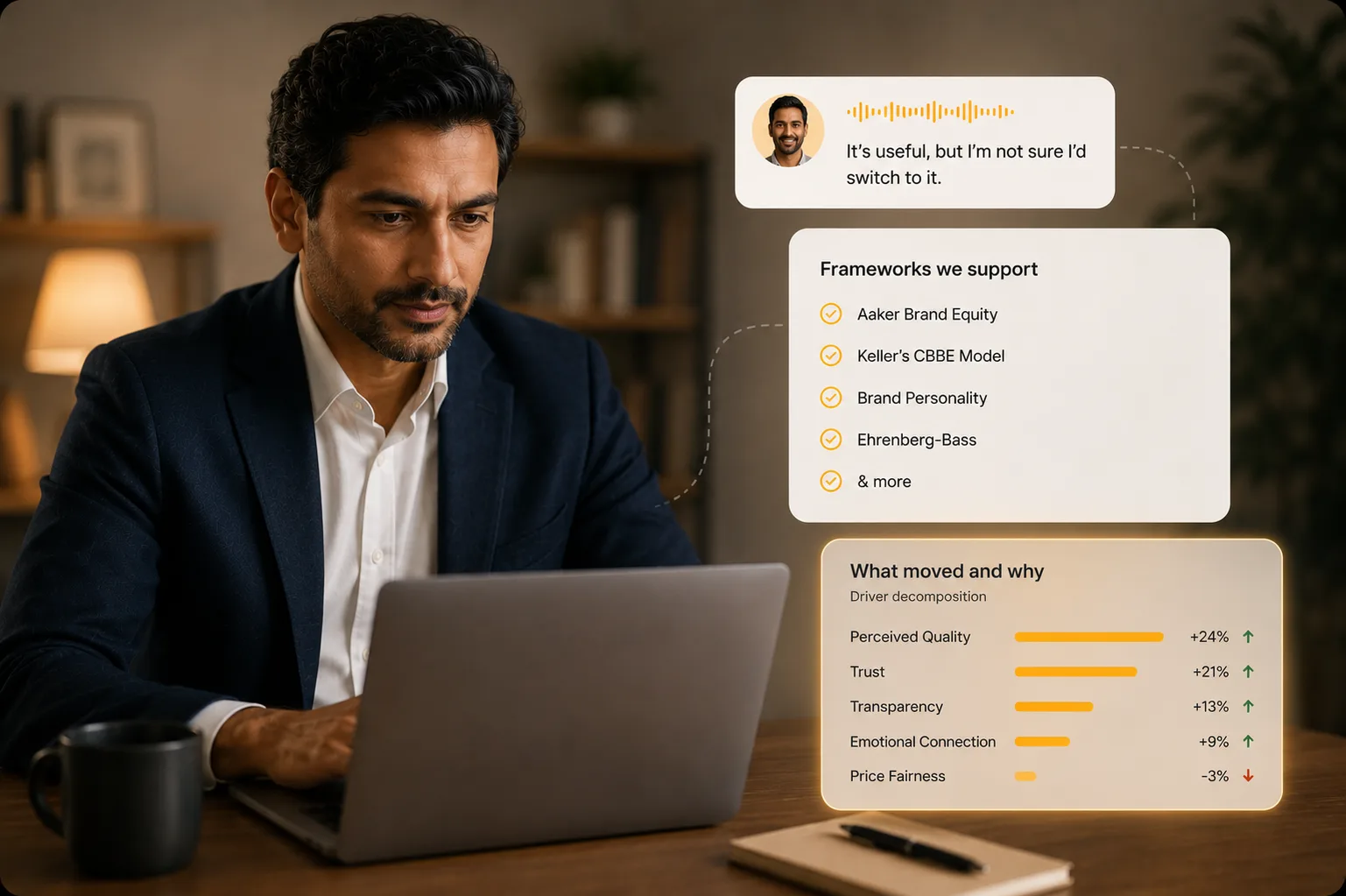
Brand equity tracking that tells you why, not just what
Aaker, Keller's CBBE, brand personality, Ehrenberg-Bass. Whichever framework your brand strategy requires — AI-moderated interviews, 200+ per wave, in 57 languages, with driver decomposition that shows what moved and why.
[ the problem ]
Why most brand trackers give you scores and not understanding
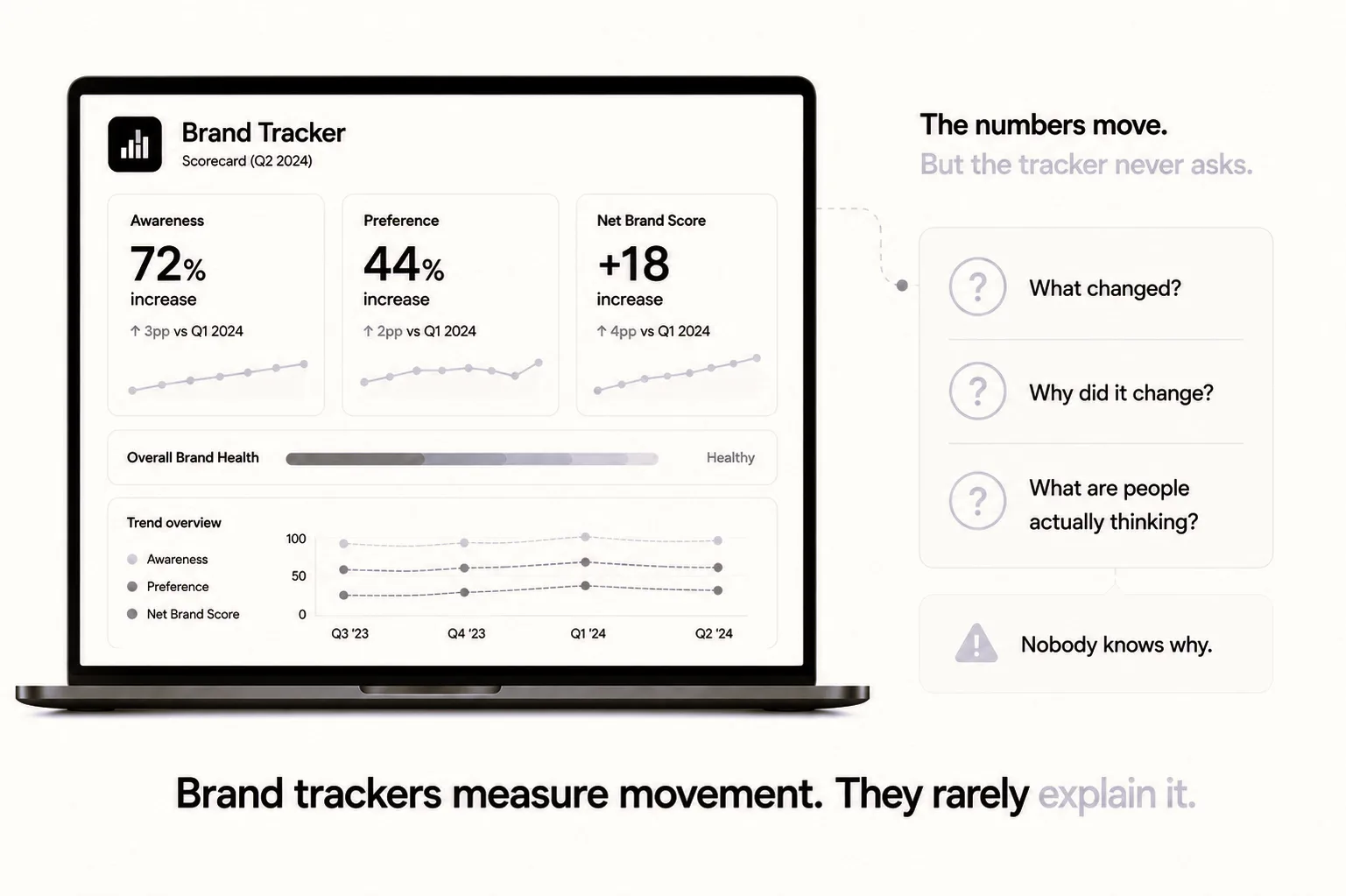
Standard brand trackers return a scorecard: awareness 72%, preference 44%, net brand score +18. The numbers move quarter-over-quarter. The brand team debates whether the shift is real or noise. Nobody knows what drove it — the tracker never asked.
The frameworks aren't the problem. Aaker and Keller built measurement instruments that work. The delivery is the problem: a fixed-question survey that records answers and never probes them.
[ how alchemic solves it ]
Three things that work together.
01
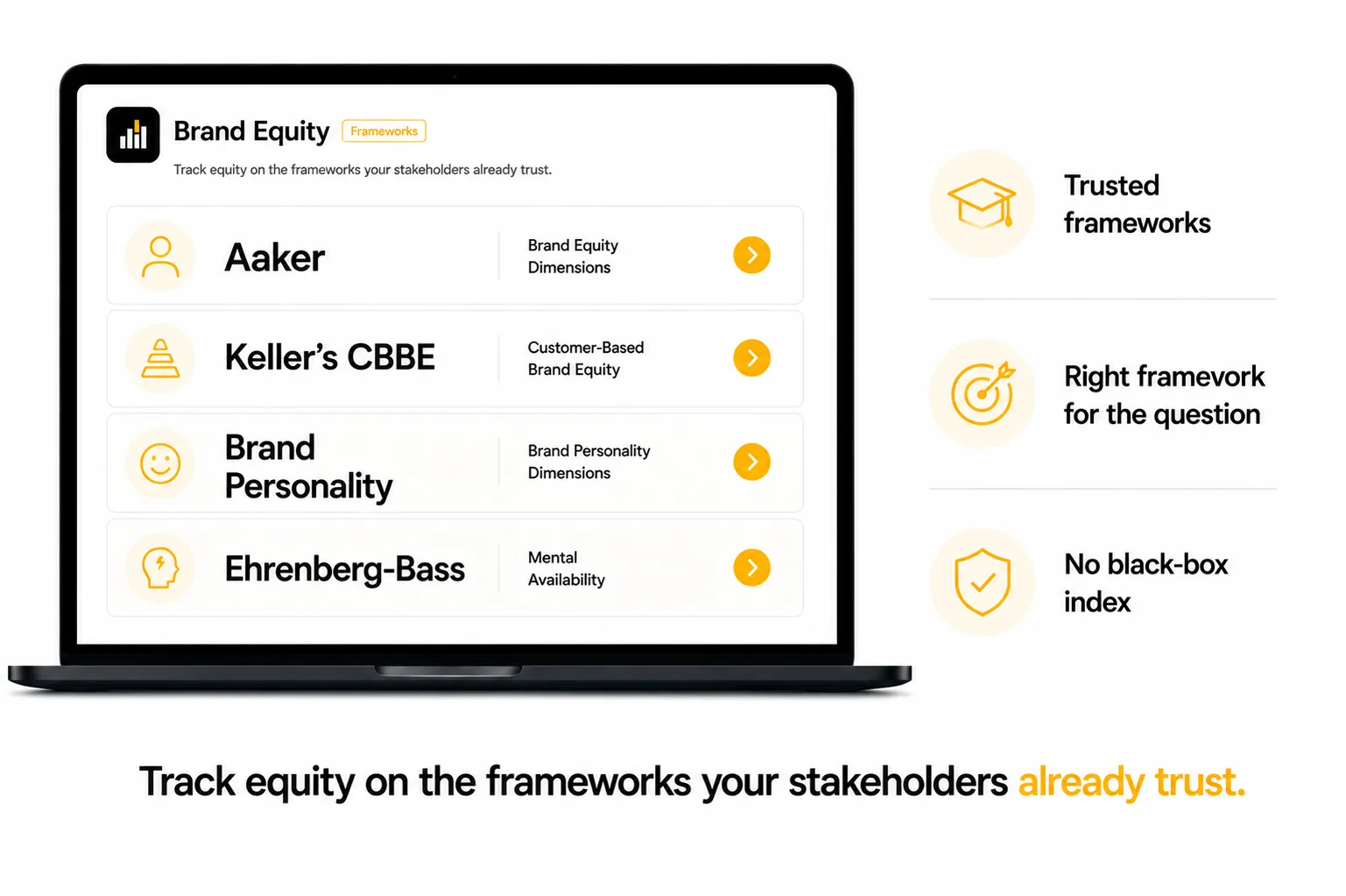
Track equity on the frameworks your stakeholders already trust
The academic frameworks are not arbitrary. Aaker, Keller's CBBE, Jennifer Aaker's brand personality dimensions, and Ehrenberg-Bass mental availability were built to measure how equity is actually constructed — validated across decades of brand research.
Pick the right framework for the question. Aaker surfaces driver strength. CBBE diagnoses where in the brand-building ladder consumers drop out. Ehrenberg-Bass measures whether your brand comes to mind when a purchase is triggered.
No proprietary black-box index. The same frameworks that appear in textbooks and boardroom decks. Your stakeholders already know what the numbers mean.
02
Trained for brand equity. Reads patterns across respondents and tensions within each one.
Alchemic's AI moderator is trained specifically on brand equity research — it knows which Aaker dimensions to probe when a respondent hedges, when a 'reliable' rating hides ambivalence, and what a senior moderator would follow up on next.
Most AI research tools read horizontally — patterns across hundreds of responses. So does Alchemic. But the qualitative signal isn't only in the patterns. It's in the tensions within each respondent's own answers — when someone rates trust high and then describes a workaround that says they don't really trust the brand. Alchemic reads both axes. The nuance qual is meant to capture stays intact.
Driver decomposition shows what moved, wave over wave. 200+ conversations per wave, depth of a senior moderator.
See how Alchemic AI moderation works →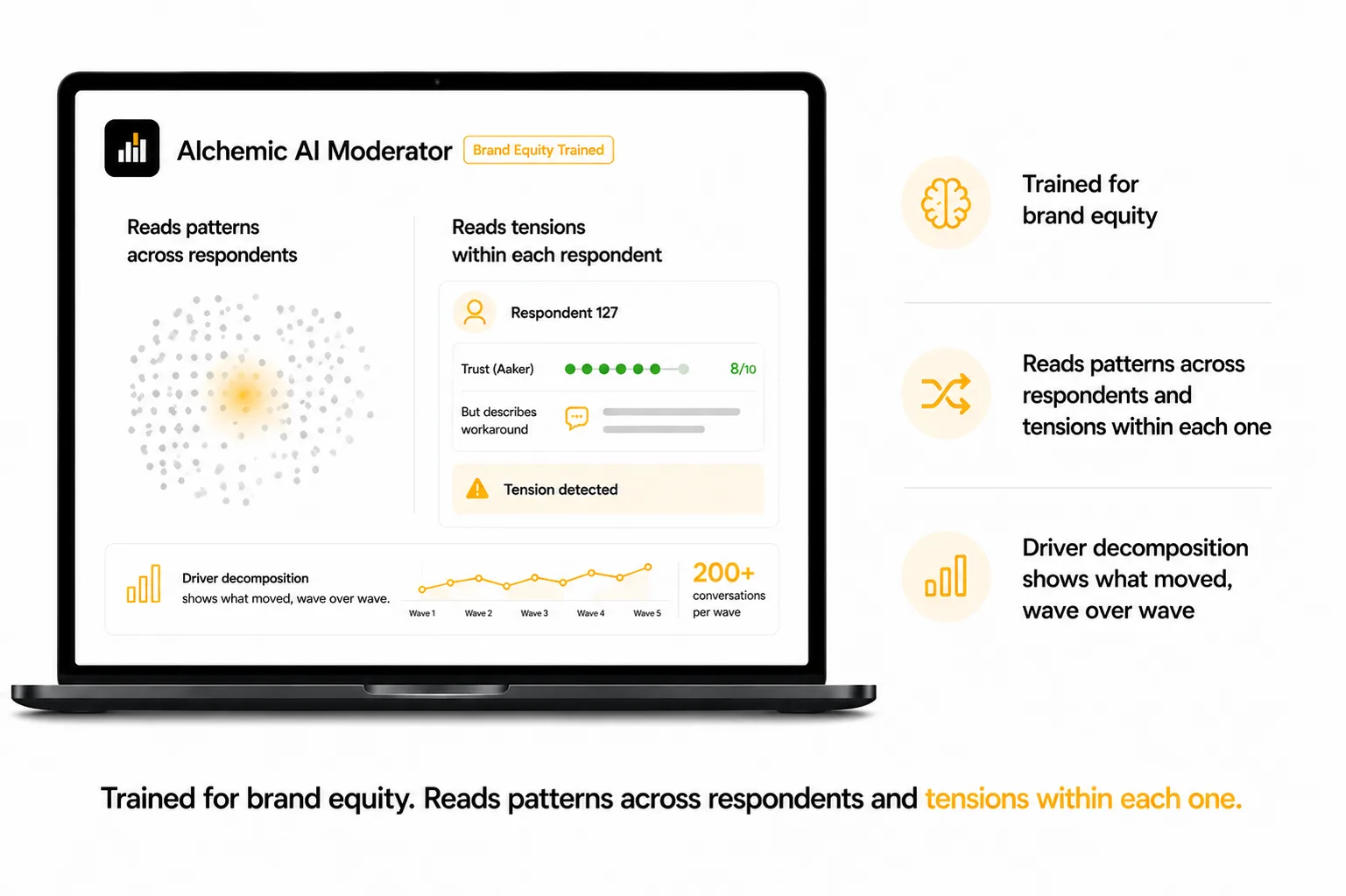
03
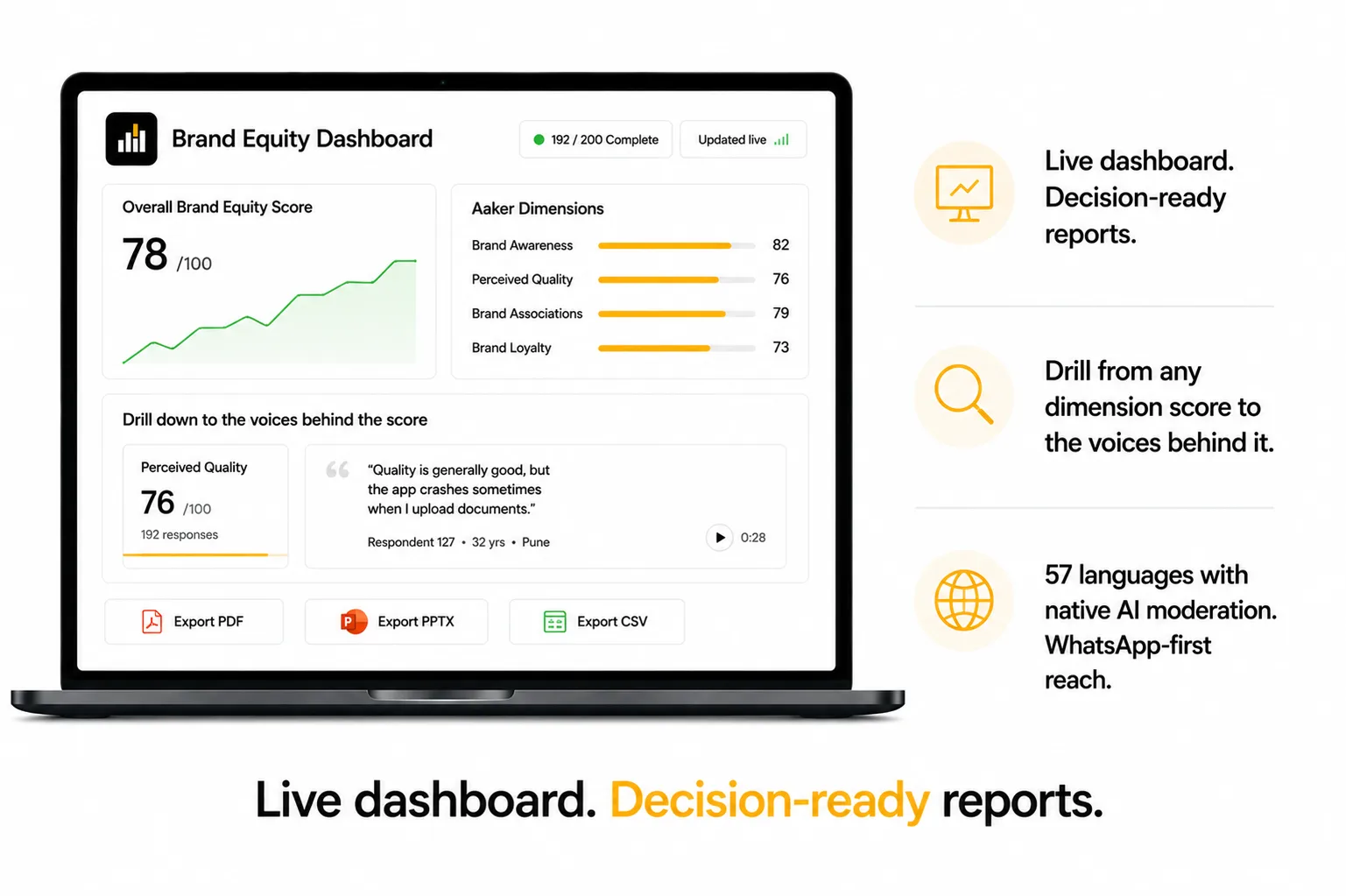
Live dashboard. Decision-ready reports.
The dashboard updates as interviews complete. By 150, driver patterns are stable. By 200, the report is effectively written.
Drill from any dimension score to the respondents behind it — the exact quote, the voice note moment. Export PDF or PPTX for the boardroom, CSV for your analytics team.
57 languages with native AI moderation — not translation. WhatsApp reaches Tier-2 and Tier-3 respondents who don't complete web surveys. Every market, every channel, same framework.
[ vs. ]
How Alchemic compares
Survey trackers give you the quant without the depth. Qual audits give depth without scale or comparability. Alchemic gives both — 200+ adaptive interviews per wave, on the framework your brand strategy requires, with driver decomposition that shows what moved and why. For normative benchmarks from a syndicated database, the established tracking vendors serve that well. For understanding what is behind the numbers, that is where Alchemic works best.
| Survey brand tracker | Qual brand audit | Brand lift study | Alchemic | |
|---|---|---|---|---|
| Interviews per wave | 200–500 (fixed questions) | 8–15 focus group respondents | Pre/post ad exposure samples | 200+ adaptive interviews |
| Frameworks supported | Custom or proprietary | Researcher-dependent | Recall + attitude only | Aaker, Keller CBBE, personality, Ehrenberg-Bass |
| Qualitative depth | Open-end box only | Full depth, low scale | None | AI probes every score |
| Wave-over-wave comparison | Yes, quant only | Rarely structured | Yes, quant only | Quant + qualitative driver shift |
| Turnaround per wave | 2–4 weeks | 4–6 weeks | 2–3 weeks | 7–10 days |
| Languages | Available, post-hoc translation | One per session | Limited | 57 natively |
| Driver decomposition | Statistical only | Researcher interpretation | Not available | AI-coded themes + quant correlations |
| Market reach | Panel-dependent | Metro and accessible | Panel-dependent | Tier 1–3, WhatsApp, voice |
Running a campaign and need pre/post ad testing alongside equity tracking? Ad Testing → Testing a new concept before launch? Concept Testing →
[ use cases ]
Where brand equity tracking with Alchemic works
FMCG annual brand health audit
Full Aaker-framework tracker across your competitive set — Tier 1 through Tier 3, Hindi and regional languages. Benchmark equity dimensions pre- and post-campaign. Driver decomposition shows which associations moved and why, comparable across waves.
BFSI trust and preference tracking
Track brand trust, perceived reliability, and mental availability in key financial decision contexts. Keller's CBBE ladder maps where consumers drop out of the brand-building sequence. AI probing surfaces the specific associations driving or blocking trust.
Tech and SaaS brand preference
Track brand preference, perceived innovation, and mental availability across user and non-user segments. Ehrenberg-Bass category entry point analysis shows which use cases trigger each brand. Longitudinal tracking separates brands building genuine equity from those buying temporary recall.
New brand entering an established category
Map the mental territory incumbents control. Find the whitespace in associations, occasions, and personality dimensions a challenger can own. Track mental availability month-over-month as awareness campaigns run.
Post-campaign brand equity measurement
Measure whether a brand campaign moved equity dimensions — not just awareness. Track change in brand personality scores, association set, and purchase intent in the target segment. Confirm whether intended associations transferred, or consumers noticed the ads but encoded something different.
Retail and D2C brand building
Track brand equity where purchase actually happens: kiranas, modern trade, quick commerce, D2C. Mental availability at the shelf is different from mental availability when ordering online. Category entry point analysis maps both.
Trusted by brand and insights teams at








Frequently asked
About this product
What is brand equity?
Brand equity is the value a brand adds beyond functional attributes — why consumers pay a premium, choose it over a similar alternative, or feel an emotional connection. It is built from awareness, associations, perceived quality, and loyalty, and tracked over time to show whether brand-building investments are paying off.
How is brand equity measured?
Through a combination of quantitative scores (awareness, preference, NPS, price premium willingness) and qualitative depth (the associations and mental images that drive those scores). Alchemic combines both in a single wave — structured quant builds the scorecard, AI-moderated conversations produce the why behind every number, at 200+ respondents per wave.
Aaker vs. Keller's CBBE — which model should I use?
Aaker tracks five equity drivers: awareness, associations, perceived quality, loyalty, and proprietary assets. Keller's CBBE pyramid tracks the brand-consumer relationship from awareness through resonance. Use Aaker for a broad equity audit; use CBBE to diagnose where in the brand-building ladder you are losing consumers. Alchemic implements both — many clients run Aaker as the tracker and CBBE as the strategic diagnostic.
How is mental availability different from brand awareness?
Brand awareness measures whether consumers know a brand exists. Mental availability (Ehrenberg-Bass) measures whether it comes to mind in a purchase situation — the buying contexts where it is actually retrieved. A brand can have high awareness but low mental availability if it is remembered but not recalled when it matters.
How often should you track brand equity?
Most brands run quarterly or bi-annual tracking. Fast-moving categories (quick commerce, fintech) often need quarterly; slower-moving categories (insurance, auto) can use bi-annual. Ad-hoc waves are common after major campaigns or competitive events. Alchemic supports any cadence — the template reuses across waves, so setup cost drops to near zero after the first.
What is the difference between brand awareness and brand equity?
Brand awareness is one input into brand equity — the most basic level. Brand equity encompasses all the value a brand generates: awareness, association quality, perceived quality, loyalty, and mental availability. You can have high awareness and low equity — a brand people know but don't prefer. Tracking awareness alone misses whether the brand is building real value.
How do you build a brand equity tracker for FMCG, BFSI, or tech?
FMCG: anchor to category entry points and occasions; track brand personality alongside standard equity metrics. BFSI: trust is the primary driver — track Keller's CBBE with a trust sub-scale; measure mental availability at key financial life events. Tech: preference and loyalty are driven by perceived innovation and reliability; supplement equity tracking with NPS and switch-intent probing. Alchemic tunes the framework to the category.
How much does brand equity tracking cost?
Cost depends on sample size, markets, wave frequency, and discussion guide depth. A typical single-market quarterly wave with 200 interviews costs less than a traditional focus-group study — and produces 10× the interviews. Contact Alchemic for a quote tailored to your category and tracking cadence.
About brand equity research
What is brand equity?
Brand equity is the commercial and perceptual value a brand holds in the minds of its customers beyond the functional product itself. It covers awareness, associations, perceived quality, differentiation, and emotional resonance — the reasons people choose, pay more for, or stay loyal to one brand over a cheaper alternative. Strong brand equity translates into pricing power, lower acquisition costs, and resilience during category disruption or competitive entry.
How is brand equity measured?
Brand equity is measured by combining qualitative depth on associations and emotion with quantitative scoring on awareness, consideration, preference, and perceived quality. Most modern approaches lean on Aaker's or Keller's frameworks — mapping salience, imagery, judgments, feelings, and resonance. Periodic equity studies use long-form interviews to surface the language and meaning behind the scores, so brand teams understand not just where they stand but why.
What's the difference between brand equity and brand awareness?
Brand awareness is one component of brand equity, not a synonym. Awareness measures whether people recognise or recall a brand; equity measures the full structure of meaning around it — what associations it triggers, what quality it signals, what emotions it evokes, and how differentiated it feels. A brand can have high awareness and weak equity, which is common for category leaders facing newer, more meaningful challengers.
What are the most important brand equity dimensions to track?
The core dimensions to track are salience, associations, perceived quality, differentiation, and emotional resonance. Salience captures top-of-mind presence; associations cover the imagery and meaning attached to the brand; perceived quality drives pricing power; differentiation signals defensibility against competitors; and emotional resonance predicts loyalty. Most equity frameworks — Aaker, Keller — are variations of these five. Tracking all of them gives a complete read on brand health at a point in time.
How often should brand equity be measured?
Brand equity should be measured deeply once every 12 to 24 months, with lighter pulse checks in between. Equity moves slowly — associations, perceived quality, and emotional positioning shift over quarters and years, not weeks — so a deep annual or biennial study is usually right. Brands going through repositioning, major campaigns, or competitive entry should add a follow-up read 6 to 9 months after the trigger event.
What's the difference between brand equity research and brand tracking?
Brand equity research is a deep periodic study; brand tracking is a continuous lighter measurement over time. Equity studies map the full structure of a brand at one point — associations, meaning, differentiation, emotional pull — usually annually or biennially. Tracking monitors a smaller set of metrics (awareness, consideration, preference, NPS) continuously to catch movement early. The two work together: tracking spots the change, equity research explains it.
Can brand equity be measured qualitatively, or does it require quantitative data?
Brand equity can and should be measured qualitatively, alongside quantitative scoring. Numbers tell you a brand scores 6.2 on perceived quality; qualitative interviews tell you why — the specific associations, memories, comparisons, and emotional triggers behind the score. Modern equity studies on platforms like Alchemic combine both, using AI-moderated interviews at scale to capture the language and reasoning that pure survey data flattens out.
How do you build brand equity?
Brand equity is built by consistently delivering on a clear, differentiated promise across every customer interaction over time. The mechanics: define a distinct positioning, reinforce it through product, packaging, communications, and service, and measure how associations evolve. Equity compounds slowly, then defends powerfully. Short-term promotions can move sales but rarely move equity; only sustained meaning, perceived quality, and emotional connection build the long-term pricing power and loyalty that equity represents.