
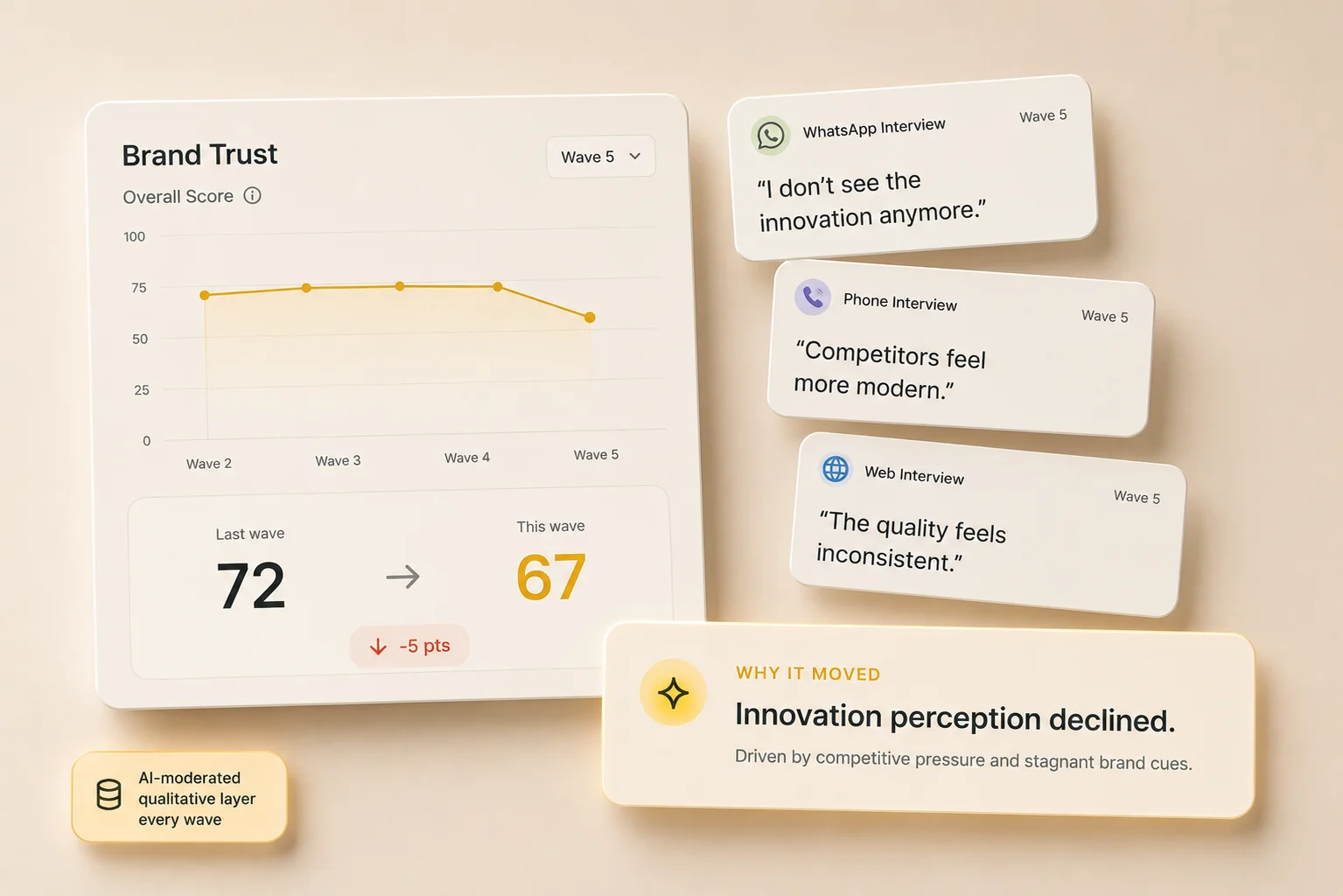
Your tracker shows the score moved. Ours tells you why.
Most brand trackers are quantitative-only — useful for the board slide, silent on the cause. Deeper Brand Tracks adds an AI-moderated qualitative layer to every wave, so the “why” lands the same week the score does.
Trusted by brand and insights teams at








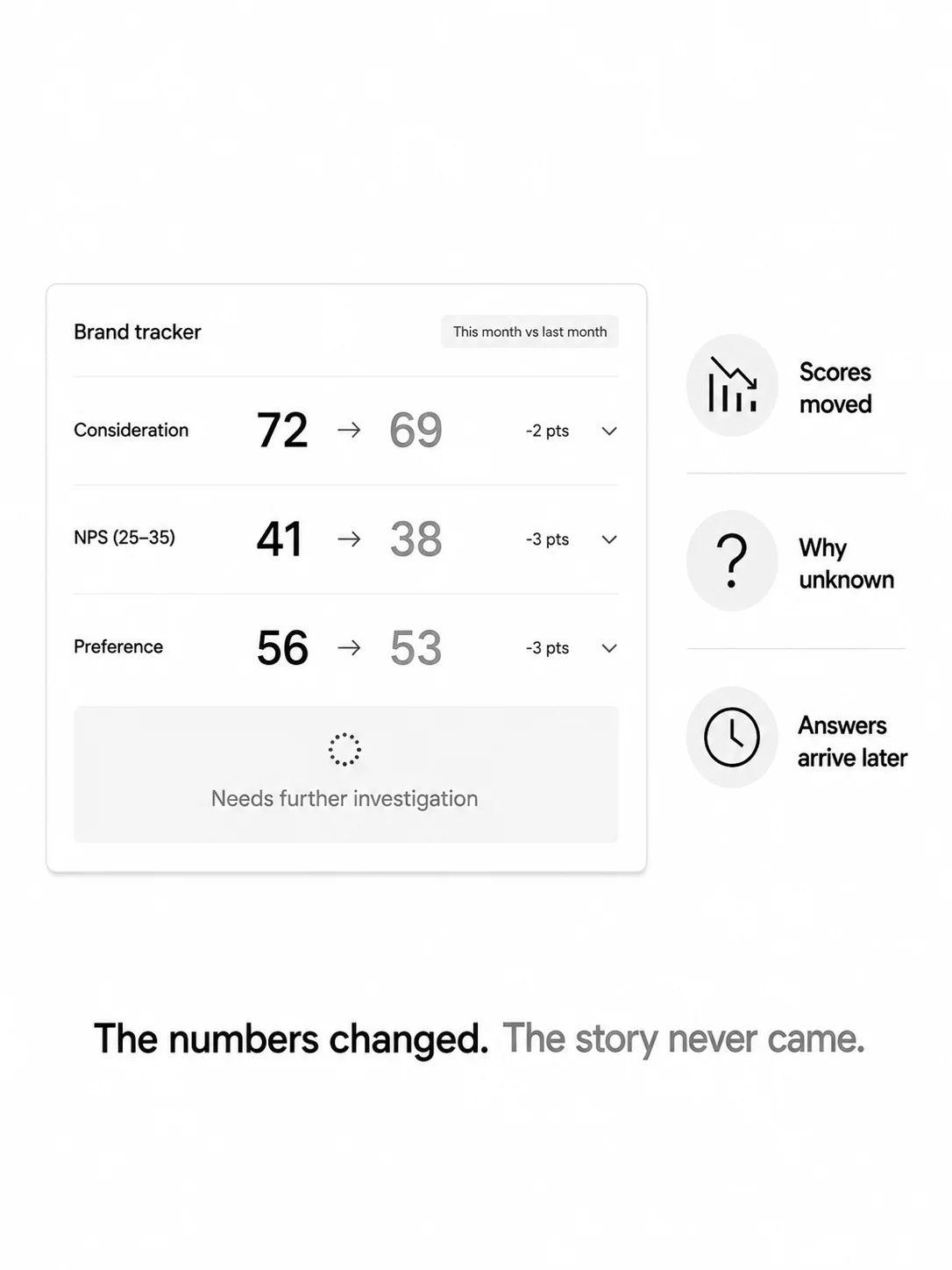
Scores move. The story arrives three months late.
Every brand insights team has the same monthly ritual. The quant tracker lands. Consideration is down two points in metros. NPS in the 25–35 segment dipped. Someone asks the obvious question — why — and the room goes quiet, because the tracker is not built to answer it.
The fix today is a separately commissioned qualitative debrief. It takes weeks to recruit, weeks to moderate, weeks to synthesise. By the time it lands, the next wave is already running and the score has moved somewhere else. So the team makes do — guesses, anecdotes, a slide that says “needs further investigation.”
The quantitative tracker is doing its job. The gap is that nothing qualitative was running alongside it on the same cadence. That is the gap DBT closes.
Three things that make it work.
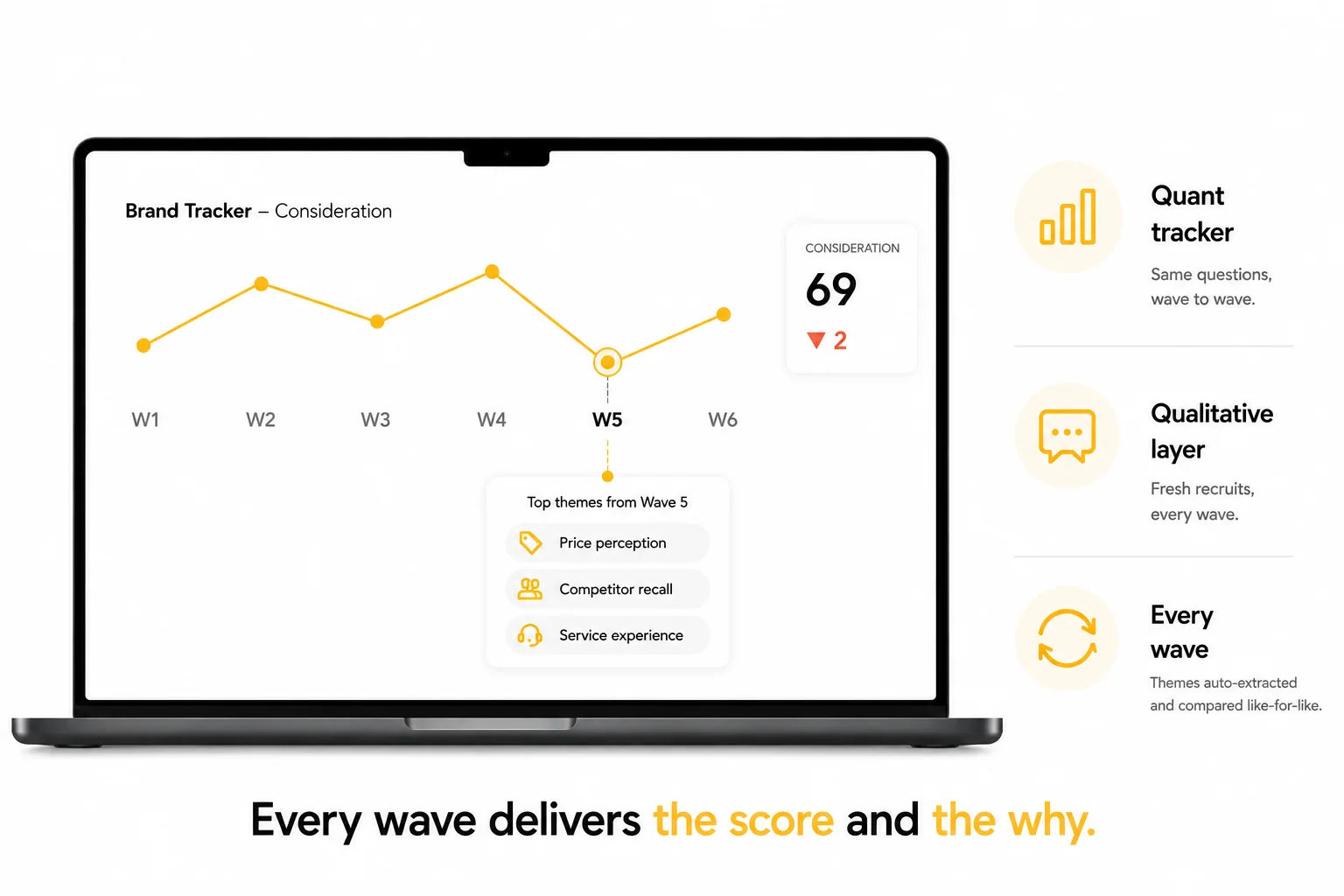
A qualitative layer on every wave, not just the annual deep dive.
Every time your quant tracker fields, Alchemic fields too — a smaller qualitative sample (typically 40–80 respondents per wave) interviewed by an AI moderator on WhatsApp, web, or phone. Same questions wave to wave, fresh recruits each time, themes auto-extracted and compared like-for-like. You stop waiting for the once-a-year qualitative debrief and start getting the “why” on the same cadence as the score.
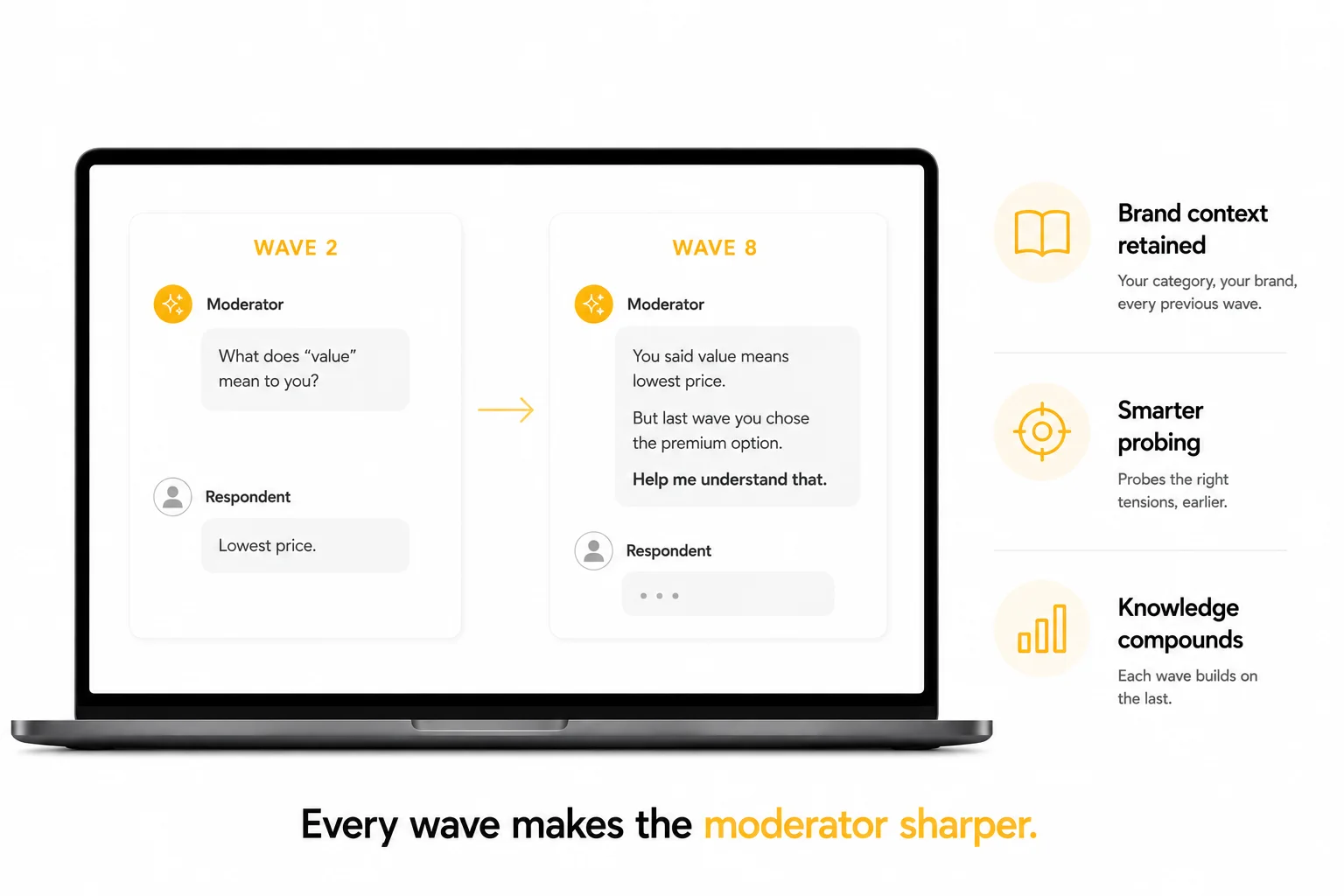
A moderator that learns your brand, wave after wave.
The AI moderator is trained on your category vocabulary, your brand context, and every previous wave it has run. By wave four it is probing the specific tension that surfaced in wave two. By wave eight it knows which segments give which answers and pushes harder where the signal is weak. Knowledge compounds. Traditional trackers cannot do this because their fieldwork crews change every cycle.
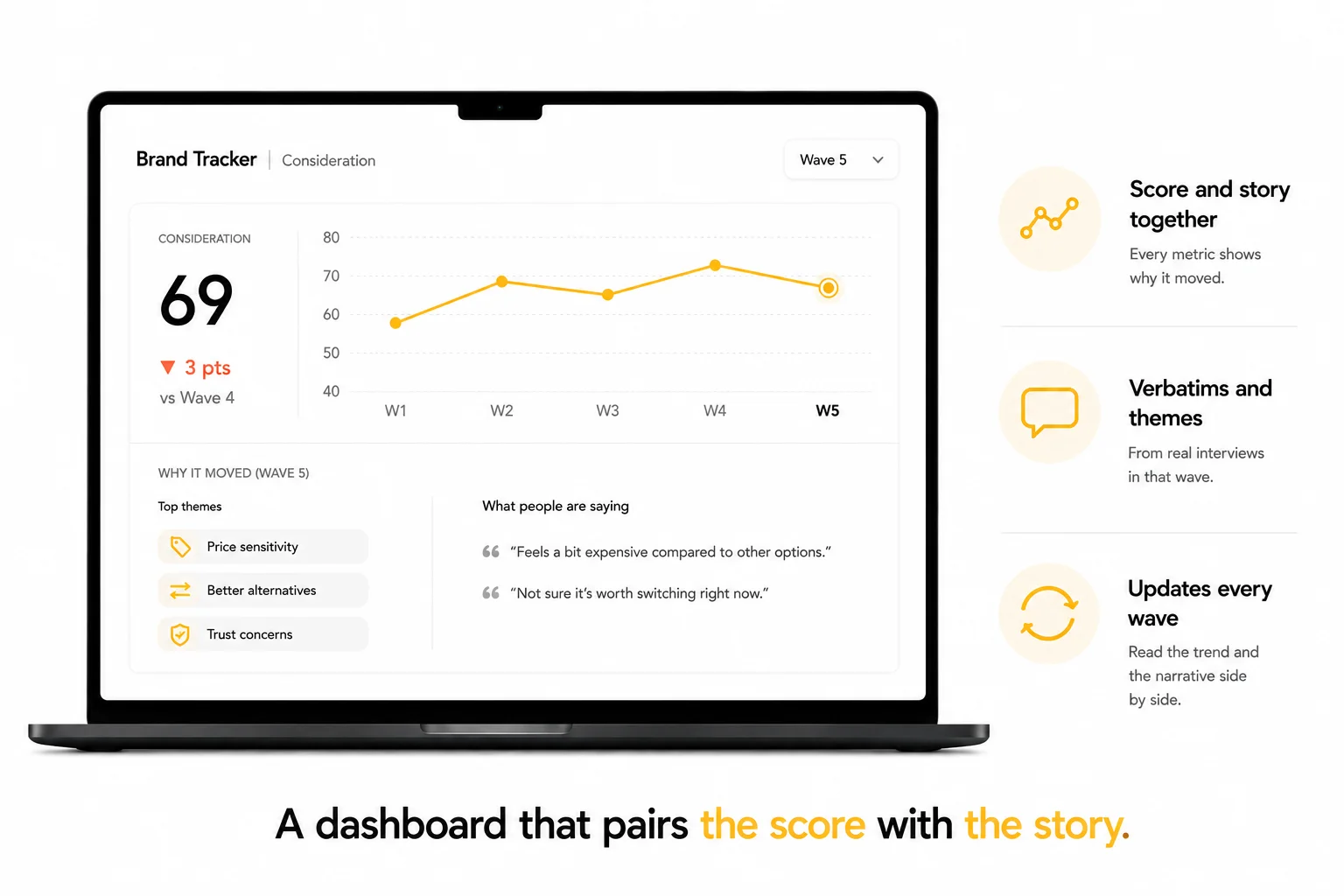
A dashboard that pairs the score with the story.
Every metric in your tracker — awareness, consideration, perception, NPS, attribute scores — gets a “why it moved” panel underneath, populated with verbatims and themes from that wave's qualitative interviews. When the next wave lands, the panel updates and you can read the trend line and the narrative side by side. No more decks where the chart and the quote are in separate documents commissioned six months apart.
From brief to insight in three steps.
Step 1
Set the discussion guide once, lock the wave cadence.
We build a qualitative discussion guide aligned to your existing tracker questions, then lock the cadence — monthly, quarterly, whatever your quant runs on. Same guide every wave, same comparable signal.
Step 2
AI moderator interviews on WhatsApp, web, or phone.
Every wave, fresh respondents are recruited and interviewed by the AI moderator in their preferred channel and language. Voice notes preserved. Probes adapt to what each respondent actually says, not a fixed script.
Step 3
Themes paired with your scores in the dashboard.
The dashboard plots scores wave-over-wave with a "why" panel under each metric — themes, cited verbatims, segment cuts. Share the chart and the story in the same view, in the same week.
[ why alchemic ]
What makes this different.
Built for waves, not one-off projects.
Most AI research platforms are built around the ad-hoc study — set it up, run it, write it up, move on. DBT is built for recurring fieldwork on a fixed cadence with the same instrument, so wave-over-wave comparison is the default behaviour, not a manual reconciliation.
The moderator compounds across waves.
The same AI moderator runs every wave for your brand and remembers what it heard last time. Probes in wave five draw on themes from wave two. A traditional tracker resets every cycle; DBT gets sharper.
Multi-channel reach, same instrument.
The AI moderates on WhatsApp, web, or phone — so you can reach the WhatsApp-first respondent in Tier 2 and the web-comfortable respondent in metros with the same guide, the same wave, the same comparable output. No splitting samples by methodology.
Sits next to your quant tracker, doesn't replace it.
DBT is not pitching itself against Kantar or Ipsos. Keep the quant tracker for the scores. Add DBT for the why. Most insights teams find the two together unblock decisions the quant alone could not.
[ use cases ]
What brands track.
Brand health pulse
Run a qualitative pulse alongside every wave of your quant brand tracker.
“Consideration dropped 3 points this wave in 25–35 metros — what shifted in their perception of us?”
NPS detractor diagnosis
Probe every wave into what detractors are actually frustrated by, in their own words.
“What specifically made you mark us a 4 this month, and what would have made it a 9?”
Category sentiment tracking
Track how attitudes to the whole category are evolving — not just to your brand.
“How has the way you think about premium skincare changed over the last six months?”
Competitor perception drift
Catch when a competitor's positioning starts landing differently with your audience.
“When you think of Brand X today, what comes to mind — and has that changed?”
[ the comparison ]
How Alchemic compares.
Traditional quant trackers deliver scores on cadence but leave the 'why' to a separate qualitative debrief commissioned weeks later. DBT closes that gap on the same wave, at a fraction of the cost.
| Attribute | Traditional quant tracker | Deeper Brand Tracks |
|---|---|---|
| Primary output | Numeric scores, scorecards | Numeric scores plus wave-matched qualitative themes and verbatims |
| Wave cadence | Quarterly, sometimes monthly | Same cadence, no slowdown |
| Time from fieldwork to ‘why’ | Weeks to months, via separate qualitative research debrief | Days, same wave |
| Channel reach | Online panel, sometimes face-to-face | WhatsApp, web, or phone — respondent's choice |
| Comparability across waves | Strong on scores, weak on qualitative research | Strong on both — same moderator, same guide |
| Knowledge compounding | Resets each wave | Moderator learns and sharpens probes wave-over-wave |
| Cost per wave for qualitative layer | Separate commission, often six-figure | Included in the recurring DBT subscription |
| Best at | Statistically defensible trend lines | Defensible trend lines with an explanation under each one |
Use Alchemic alongside your existing tracker — most brands keep their quant, add us for the qualitative layer.
Frequently asked
About this product
How is this different from your Brand Equity offering?
Brand Equity is the periodic deep dive — typically annual, framework-driven, designed to read the full structure of your brand's equity at a point in time. Deeper Brand Tracks is the recurring tracker that runs in waves alongside your quant tracker. BE answers “what does our brand mean right now”; DBT answers “where is it moving wave-over-wave, and why did it move this wave.” Most brands run both. See Brand Equity for the periodic study.
Do we have to drop our existing Kantar or Ipsos tracker?
No. DBT is built to sit next to your quant tracker, not replace it. Keep the statistically robust score line you already trust; add us for the qualitative layer on the same cadence.
How many respondents do you interview per wave?
Typically 40–80 per wave, depending on the segments you want to track. Smaller than the quant sample, but big enough to surface themes reliably and cut by 2–3 segments.
Can we keep the same moderator across waves so the comparisons are clean?
Yes — that's the default. The same AI moderator, trained on your brand and category, runs every wave. Themes are auto-aligned wave-over-wave so you can read trends without manual coding.
Which channels can the AI moderator interview on?
WhatsApp, web, or phone. You can mix channels in a single wave if your audience is split, or pick the one channel that gets your respondents to engage best.
What does the deliverable look like each wave?
A live dashboard that plots scores wave-over-wave with a "why it moved" panel under each metric — themes, cited verbatims, segment cuts. Export to slides when you need a shareable summary. No waiting on a separate debrief deck.
About brand tracking
What is a brand tracking study?
A brand tracking study is a recurring research programme that measures how a brand is performing in the minds of consumers over time. It typically tracks awareness, consideration, perception, equity attributes, NPS, and sentiment in fixed waves — monthly, quarterly, or biannually — so a brand can spot movements, diagnose causes, and adjust marketing investment. Traditional brand trackers are quantitative-only; newer approaches add a qualitative layer to explain the score movements on the same cadence.
How is brand tracking different from a brand equity study?
A brand tracking study is recurring and built for cadence — same questions, same instrument, every wave — so you can read trends over time. A brand equity study is a periodic, deeper evaluation — often annual — that reads the full structure of equity at a point in time using frameworks from authors like Aaker and Keller. Trackers tell you where things are moving. Equity studies tell you what the brand actually means right now. Most mature brands run both.
How often should a brand run a tracker?
The right cadence depends on category dynamics. Fast-moving categories like FMCG, fintech, or consumer tech often run monthly or quarterly. Slower-moving categories like B2B or insurance often run biannually. The principle is simple — the cadence should be fast enough to catch a movement before the cause becomes untraceable.
What metrics are typically tracked?
Common metrics include unaided and aided awareness, consideration, preference, perception attributes, NPS or recommendation likelihood, purchase intent, and emotional sentiment. Increasingly teams also track share of category conversation and qualitative sentiment themes alongside the numeric scores.
Why do quantitative brand trackers struggle to explain score movements?
Because they are designed to measure, not to diagnose. A quantitative tracker uses closed-ended scales to produce defensible scores at scale. It cannot probe — when a respondent rates the brand a 4, the tracker captures the 4 but not the story behind it. Diagnosis requires a qualitative conversation, which is why brands traditionally commission a separate qualitative debrief weeks or months after the score moves.
Can qualitative brand tracking be done at scale?
Historically, no — hand-moderated interviews could not match the cadence or sample size of a quantitative tracker. AI-moderated research has changed this. An AI moderator can run 40–80 interviews per wave on WhatsApp, web, or phone, synthesise themes automatically, and align them wave-over-wave so the qualitative layer keeps pace with the quant tracker.
Does qualitative brand tracking replace the quantitative one?
No, and it shouldn't try to. The numeric trend line is what boards and CMOs use to allocate budget — that needs to stay statistically robust. The qualitative layer complements it by explaining what is driving the movement, so the same chart in the same board pack carries both the score and the story.
How do you make qualitative findings comparable across waves?
Three things have to be held constant: the discussion guide, the moderator, and the synthesis framework. If the guide changes, you lose like-for-like comparability. If the moderator changes, probing styles drift. If themes get re-coded every wave, trend lines become noise. AI-moderated tracking holds all three constant by default, which is why it produces comparable qualitative trend lines that hand-moderated programmes struggle to.