
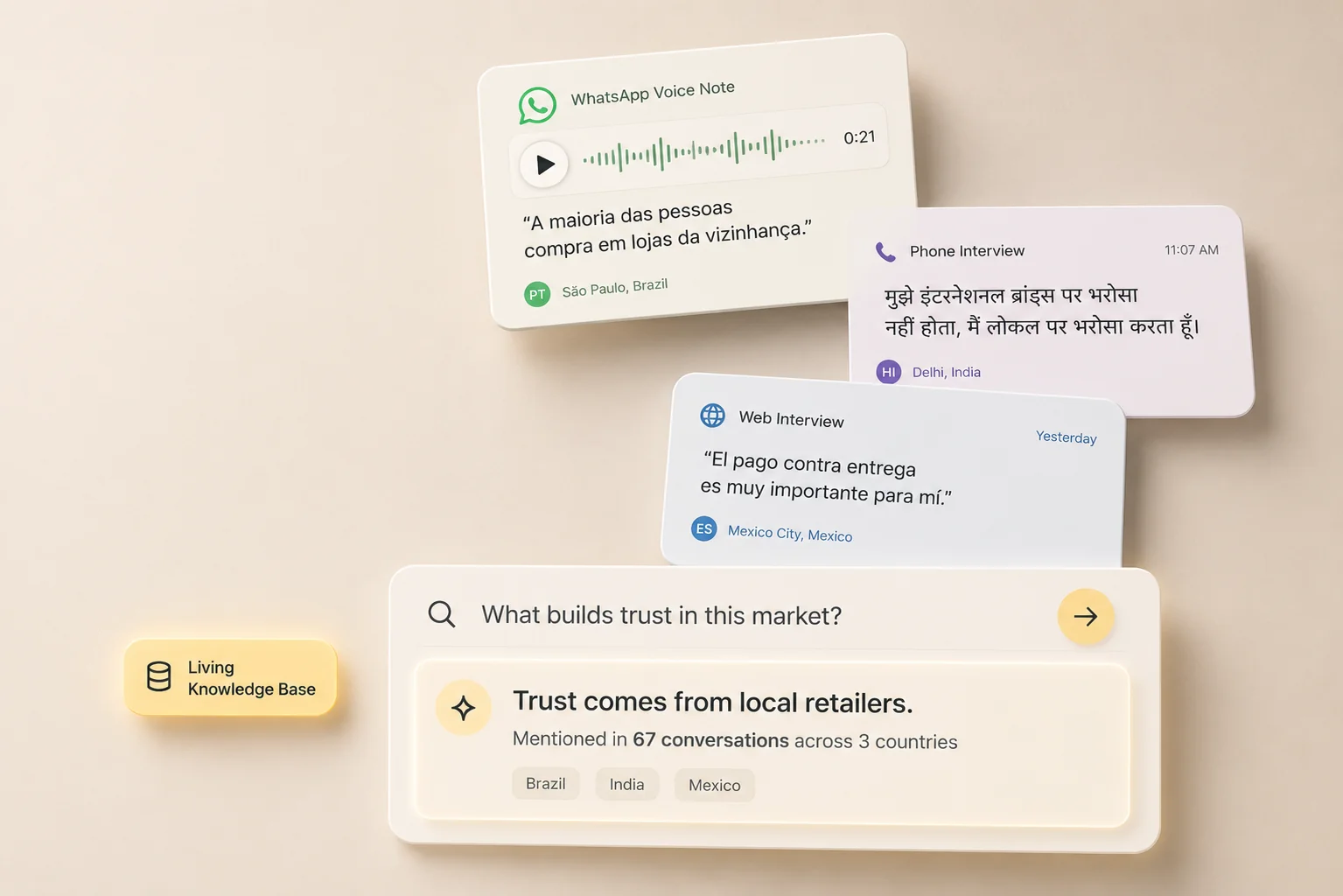
Enter a new market with conviction, not a 12-week deck.
You're launching into a geography, segment, or income band you don't yet understand. Alchemic runs deep qualitative research on WhatsApp, web, or phone in the local language — and turns every conversation into a living knowledge base your team queries long after the launch deck is forgotten.
Trusted by brand and insights teams at








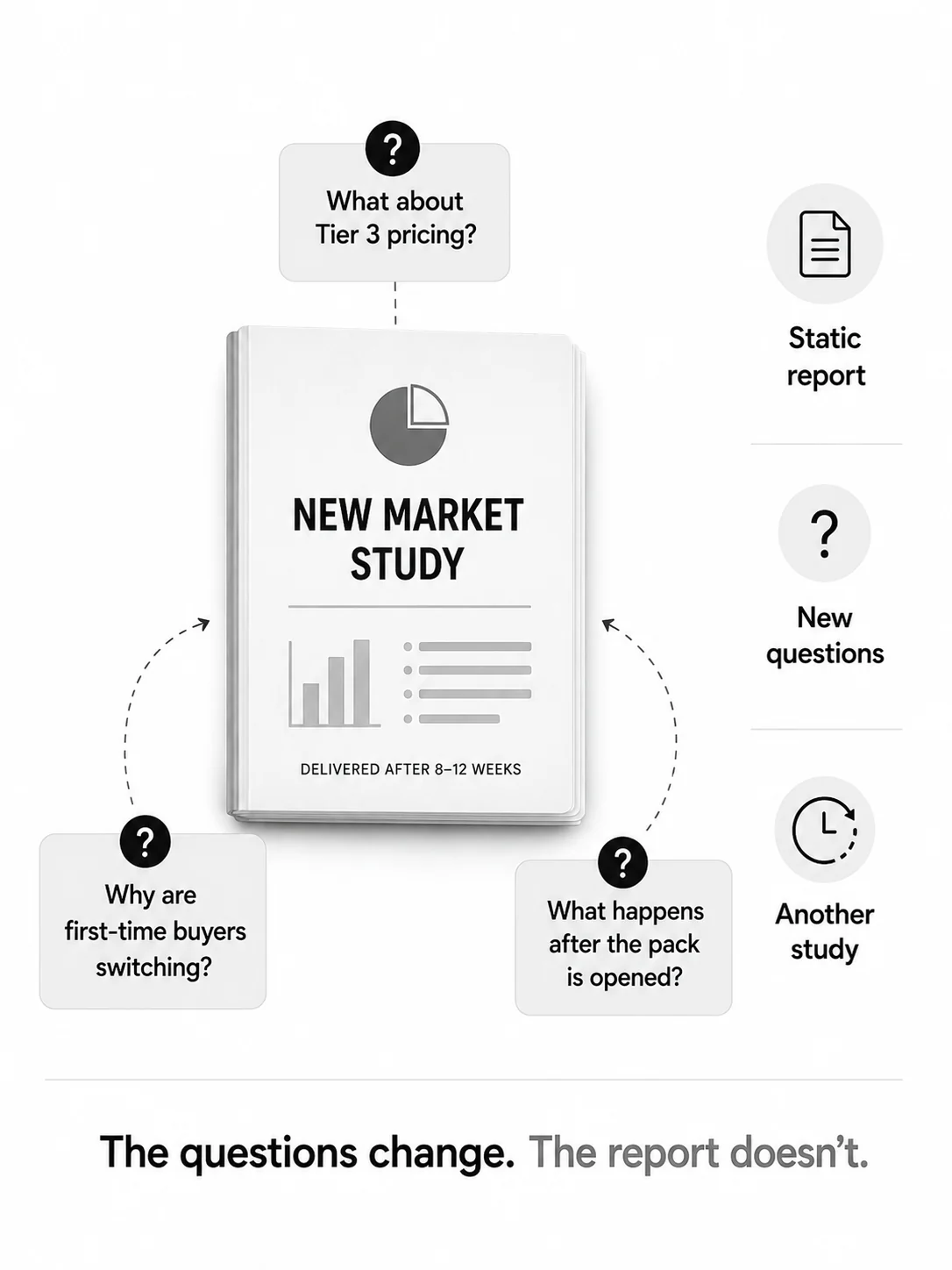
Most market-entry research dies the day it's delivered.
You commission a study to understand a new market. Eight to twelve weeks later, a deck lands. Your GTM team has already made half the calls without it. Three months in, a new question comes up — pricing in Tier 3, switching behaviour among first-time category users, what mothers actually do with the pack after opening — and the deck has no answer. The only path is another study, another timeline, another invoice.
The other problem is depth. Syndicated reports give you market size; survey panels give you what people will admit on a Likert scale. Neither tells you what people actually do in their kitchens, on their commutes, with their wallets — the texture you need to position a brand into a market you haven't lived in.
Most of the world's interesting new markets — Tier 2/3 India, Southeast Asia, LATAM, the African coastal cities — don't sit still for an hour-long Zoom. They sit on WhatsApp, in their own language, on their own schedule. Research that can't meet them there isn't research.
Three things that make it work.
Real qualitative depth, in days.
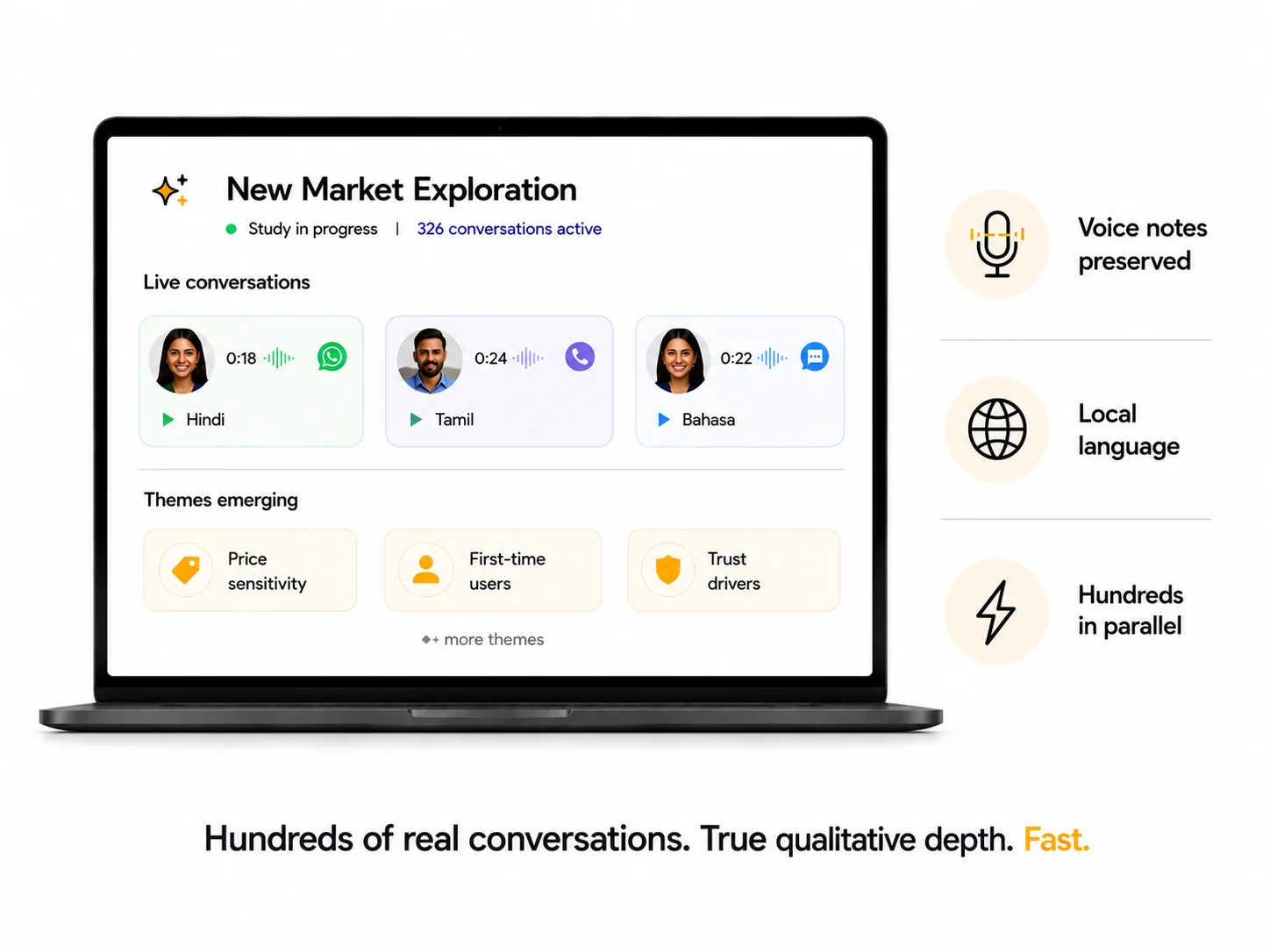
Alchemic deploys an AI moderator that runs hundreds of conversations in parallel — on WhatsApp, web, or phone — in the local language, with voice-note answers preserved as voice notes. The same study that takes a traditional agency 8–12 weeks finishes in days. Not a survey wearing a qualitative costume — actual probing, follow-up, and “tell me more about that” conducted at scale, with cited verbatims and themes auto-extracted into a live dashboard your whole team watches.
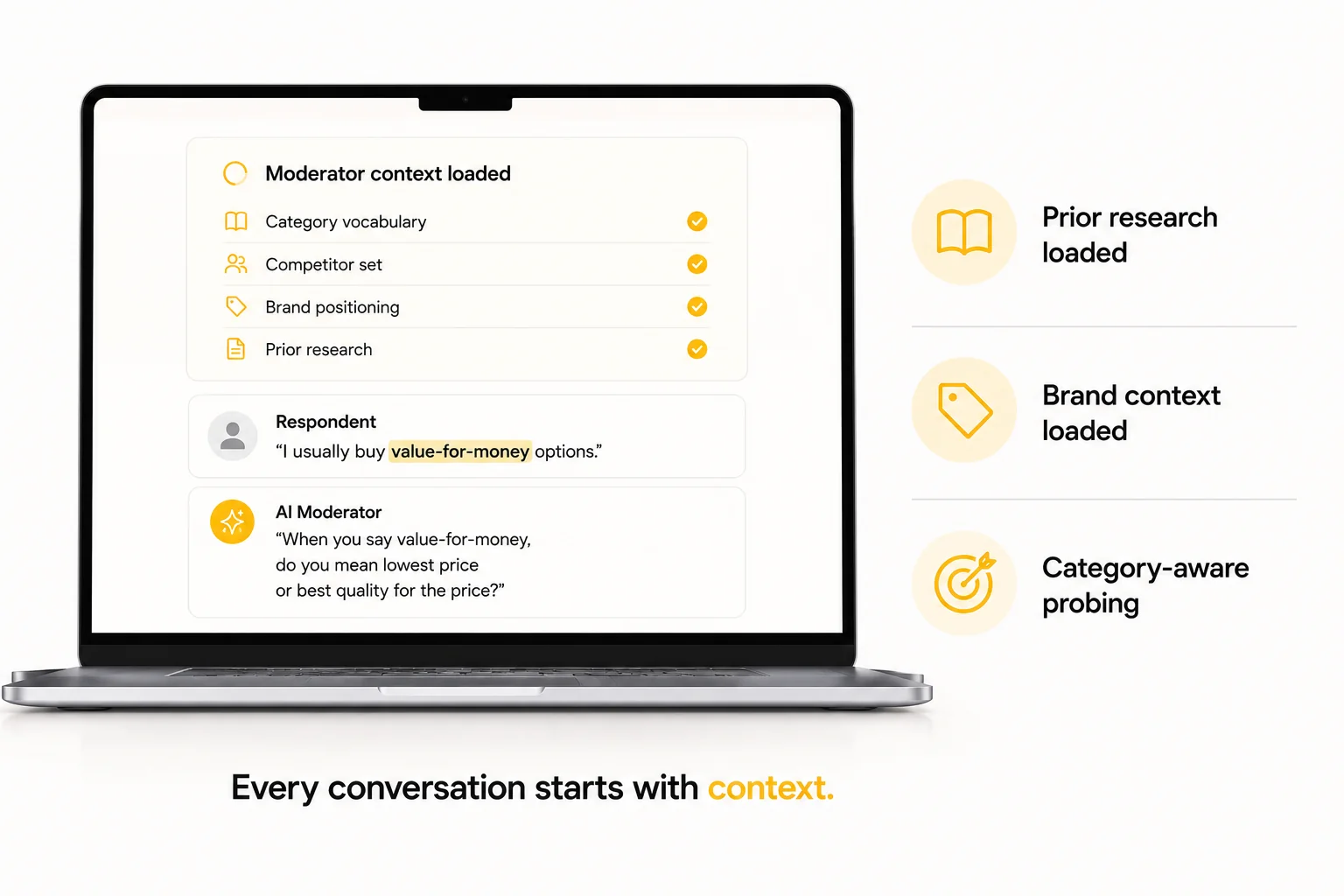
Trained on your category, brand, and prior work.
Before the moderator talks to anyone, it's grounded in your category vocabulary, your brand context, your hypotheses, and anything you've researched before. So it knows the difference between “value” and “discount” in your category. It knows which competitors to probe. It knows the language your buyers use, not the language a generic LLM would assume. The deeper you go with Alchemic, the sharper the moderator gets — because everything you've already learned is in its head.
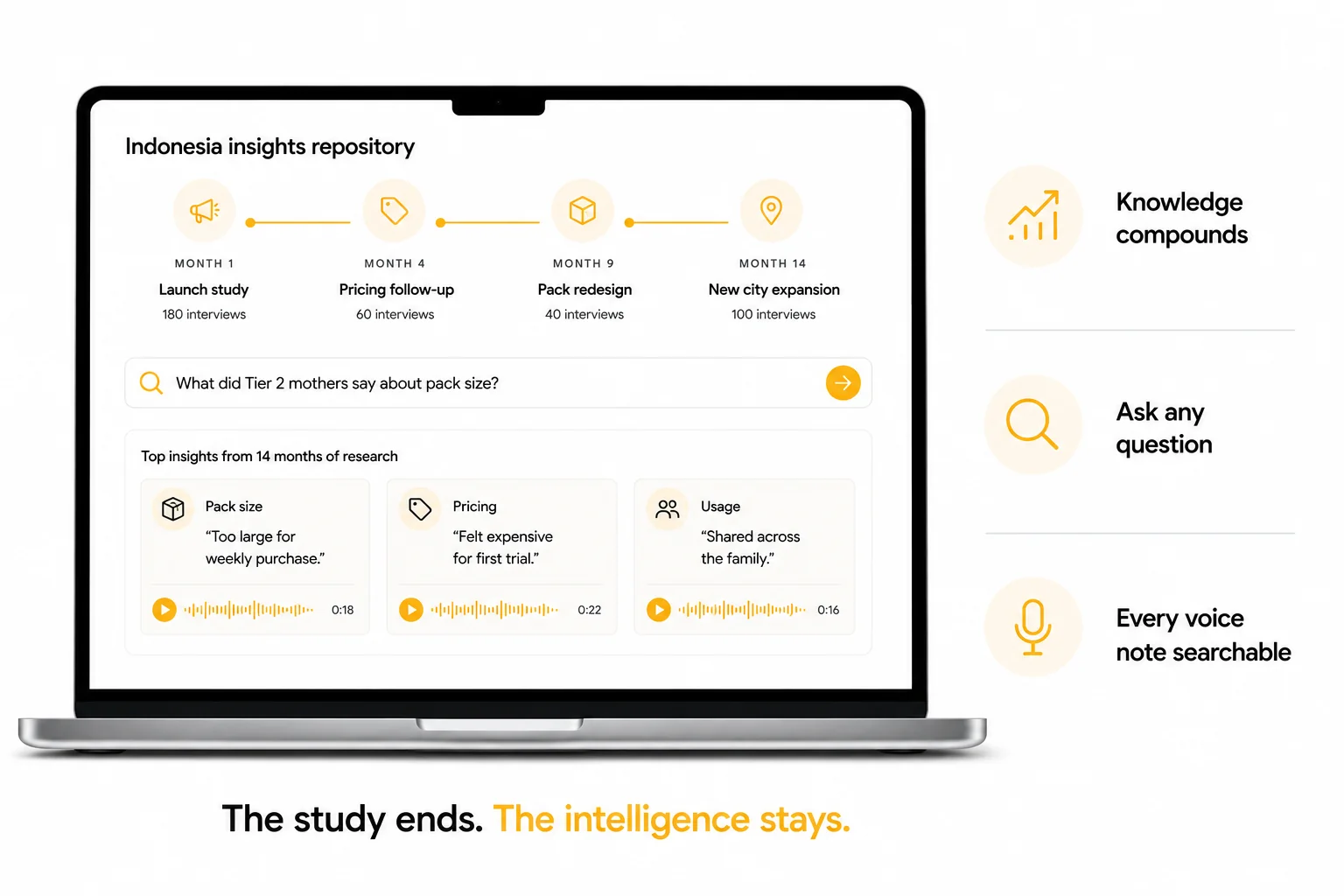
The study becomes a permanent knowledge base.
Every interview, every voice note, every theme is written into your Alchemic insights repository — a living layer your strategy, brand, and CX teams query in plain English from Slack, Teams, or WhatsApp. “What did Tier 2 mothers say about pack size?” “What was the top objection to our pricing?” The market-entry study isn't a deliverable that ages out — it's the seed of your permanent customer intelligence for that market.
From brief to insight in three steps.
Step 1
Brief the moderator.
Share your hypotheses, the market, the segment, and any context — past research, brand decks, category data. The AI moderator absorbs it and builds a discussion guide you can edit line by line before fielding.
Step 2
Field at scale, in their language.
Recruit through your panel or ours. Respondents talk to the AI moderator on WhatsApp, web, or phone in their preferred language, at their own pace. You watch the dashboard fill in real time over a few days, not weeks.
Step 3
Synthesise, then keep building.
Themes auto-extract with cited verbatims and voice clips intact. Findings land in your insights repository where every future study, immersion, or upload compounds on top — for as long as you sell into that market.
[ why alchemic ]
What makes this different.
Days, not months.
A market-entry study that fits inside a sprint, not a quarter. Field over a long weekend, synthesise the next morning, brief the GTM team before the next stand-up. You don't have to slow the launch down to wait for insight.
Real qualitative depth — not a survey in disguise.
The moderator probes, follows up, asks "what do you mean by that," holds silence, listens to a 90-second voice note about a woman's first credit card. You get the texture syndicated reports and Likert panels can't see — the kind GTM teams actually use to make calls.
Compounding knowledge base, not a deck.
The study writes into a living repository your team queries in plain English from Slack, Teams, or WhatsApp. Every follow-up study, immersion, or upload makes the next answer sharper. (See /insights-platform/ for how the repository works.)
Built for where new markets actually live.
WhatsApp, regional languages, voice notes, low-bandwidth mobile, respondents on their own time. Tier 2/3 India, SEA, LATAM, MENA — the geographies where traditional CATI and Zoom-based qualitative research quietly fall apart.
[ use cases ]
What brands discover.
New country launch
Test category fit, brand resonance, and pricing tolerance before you commit a single rupee of trade spend.
“How do first-time buyers in Indonesia think about our category — and what's the first objection a retailer will hear?”
New city tier / income band
Move from Tier 1 metros into Tier 2/3, or from premium into mass — without flying a team in for six weeks.
“What does ‘affordable luxury’ mean to a household earning Rs 8–12 lakh a year in Surat, Lucknow, and Coimbatore?”
New demographic or life stage
A brand built for urban millennials now targeting Gen Z, or new parents, or pre-retirees — start by listening.
“How do 22–26-year-old first jobholders decide between a savings account, a UPI app, and a credit card?”
Category extension or adjacent vertical
Moving from skincare into haircare, or from B2C into prosumer — find the white space before you build for it.
“What jobs do our current customers hire other brands for that we could plausibly own?”
[ the comparison ]
How Alchemic compares.
Legacy market-entry research runs on months and seven-figure budgets. Alchemic fields and synthesises in days, at a fraction of the cost, and keeps compounding after delivery.
| Legacy market-entry research | Alchemic | |
|---|---|---|
| Time to first insight | 8–12 weeks | Days |
| Field methodology | In-person focus groups, CATI, scheduled depth interviews | AI-moderated conversations on WhatsApp, web, or phone, in the local language |
| Depth per respondent | High for small N (12–30), thin everywhere else | High qualitative depth across hundreds of respondents |
| Output format | Static PowerPoint deck | Live dashboard with cited verbatims, voice notes preserved, plus a queryable knowledge base |
| What happens after delivery | The deck ages out; every follow-up is a new project | Insights repository keeps compounding — every future study sharpens the last |
| Cost shape | Six- to seven-figure project fee, scope-locked | Platform pricing, scope-flexible, fraction of a single legacy study |
| Local language and channel fit | Translation layer, mostly metro-recruited respondents | Native-language moderation on the channels respondents actually use |
| Team time required | Heavy briefing, mid-point readouts, final debrief sessions | Brief once, watch the dashboard, query the repository on demand |
If you genuinely need a partner to walk a board through a 200-slide narrative, the legacy firms still do that well. For everything else — the work that actually shapes the launch — Alchemic is the faster, deeper, more permanent answer.
Frequently asked
About this product
How long does a typical market-entry study take?
From brief to dashboard-ready themes, most studies finish inside a week. Fielding itself usually takes 3–5 days depending on sample size, market, and language. Compare that to the 8–12 weeks the legacy method demands.
Which languages does the AI moderator support?
Hindi, Tamil, Telugu, Kannada, Marathi, Bengali, Gujarati, Bahasa, Vietnamese, Thai, Spanish, Portuguese, Arabic, and more. If your target market speaks it, ask us — we've probably already run a study in it.
How do you handle low-literacy or low-bandwidth respondents?
The moderator can run entirely on WhatsApp voice notes or over a phone call — no app to install, no typing required. Respondents talk; we transcribe, translate, and synthesise.
Can I bring my own respondent panel or do you recruit?
Either. Plug in your CRM or partner panel, or use ours. Tier 2/3 India and most SEA/LATAM markets are covered.
How is this different from /insights-platform/?
This page is the study — a market-entry research project, scoped and delivered. The insights platform is the layer where that study and every follow-up lives, gets queried, and compounds over time. You don't choose between them; the study seeds the platform.
Can a non-researcher on my team use this?
Yes. The dashboard is built for strategy leads, brand managers, and CX heads — not just trained researchers. You can read themes, watch verbatims, and ask follow-up questions in plain English without ever opening a CSV.
About market entry research
What is market entry research?
Market entry research is the qualitative and quantitative work a brand commissions before launching a product or service into a new geography, city tier, demographic, income band, or category. The goal is to understand the new customer deeply enough to make positioning, pricing, distribution, and creative decisions with conviction instead of guesswork. Traditional market entry research is run by management consultancies or large research firms over 8–12 weeks; modern AI-moderated platforms compress the same depth into days.
How long does a traditional market entry study take?
A full market entry engagement at a Big 3 consulting firm typically runs 8–12 weeks end-to-end. The primary research subcomponent alone — fielding qualitative interviews, focus groups, and surveys — usually accounts for 3–4 weeks of that timeline. Custom qualitative studies at the large research firms (Kantar, Nielsen, Ipsos) follow similar 6–10 week cycles, ending in a static PowerPoint deliverable.
How much does market entry research cost?
Cost varies enormously by scope. A boutique qualitative study in a single market might land between $15,000 and $50,000; a custom Kantar or Ipsos engagement typically runs $75,000 to $250,000; a full McKinsey/BCG/Bain market-entry case sits in the high six to low seven figures. AI-moderated platforms run at a fraction of these costs because the moderator scales without adding human field hours.
What’s the difference between qualitative and quantitative market entry research?
Quantitative research tells you how big the market is, what share competitors hold, and what proportion of respondents prefer option A over B — it’s the numerator and denominator work. Qualitative research tells you why people behave the way they do — the language they use, the objections they hold, the trade-offs they make in real life. A serious market entry needs both, but qualitative is where positioning and creative decisions actually get made.
How do you research a new market without flying a team in?
Modern AI-moderated platforms run qualitative interviews remotely on WhatsApp, web, or phone in the respondent’s native language, with voice notes preserved. Respondents talk on their own schedule, in their own home, with no observer effect. For most markets — including Tier 2/3 India, SEA, LATAM, MENA — this produces more candid and more representative qualitative data than flying a metro-based moderator in for two days of focus groups.
What’s the right sample size for market entry qualitative research?
It depends on segmentation. For a single new geography with a homogeneous target, 30–60 well-moderated qualitative conversations will surface most major themes. For a study that needs to compare across income bands, city tiers, or life stages, plan for 100–300 conversations. AI moderation makes the larger sample sizes economically reasonable, where the legacy method forced you to choose 30 and hope for the best.
Can market entry research be re-used or does each new question need a new study?
Traditionally each new question meant a new study, because the prior research existed only as a static deck. With a modern insights repository, every interview, theme, and verbatim is queryable months and years later. Strategy and CX teams can ask follow-up questions in plain English instead of commissioning a new project for every new question.
What’s the biggest mistake brands make when entering a new market?
Two common ones. First, leaning too heavily on syndicated reports and desk research — they give you market size, not the texture you need to actually position a brand. Second, treating market-entry research as a one-off deliverable that ends with a deck, instead of as the foundation of a permanent customer-intelligence layer the brand will keep building on for the next several years.