
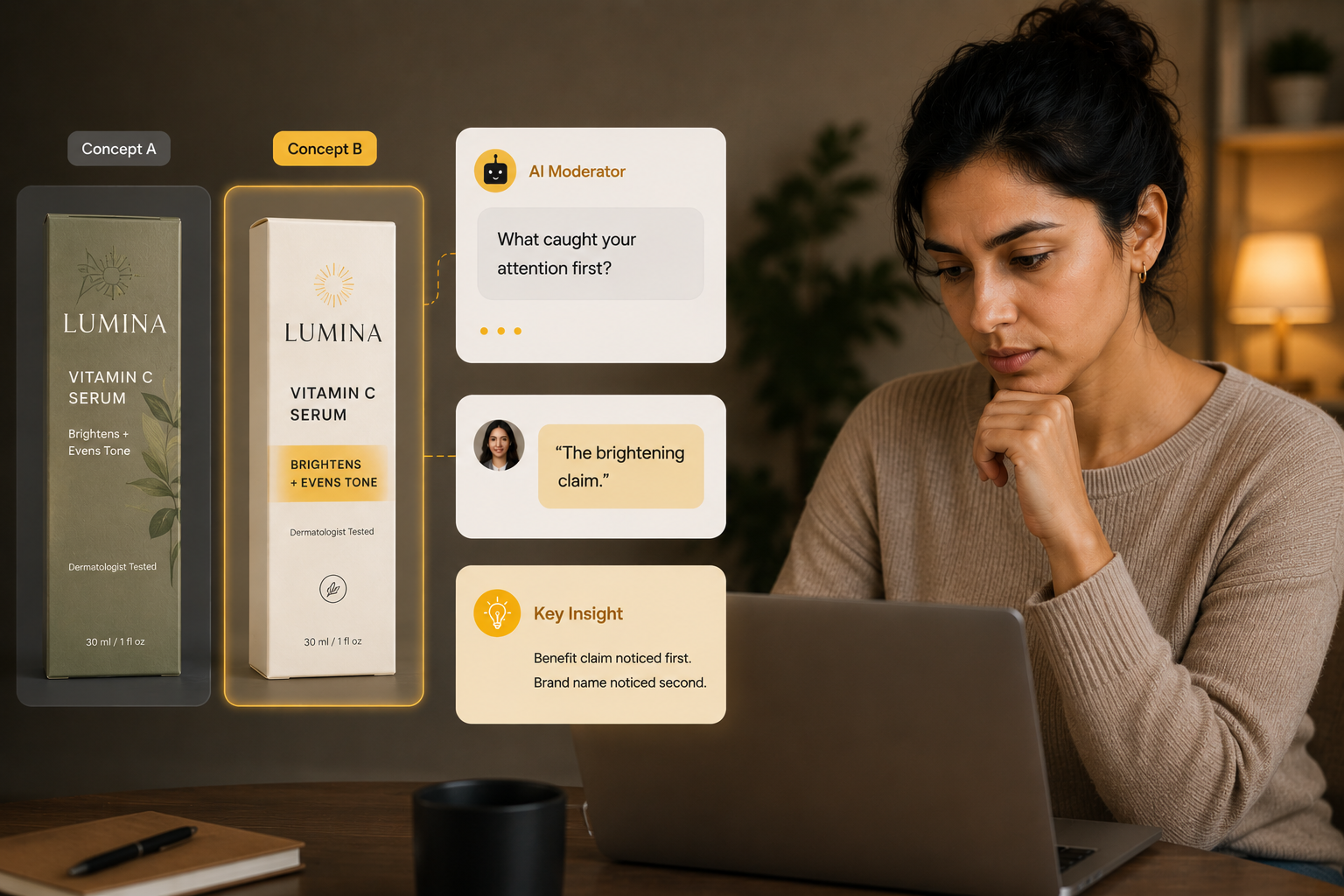
Test packaging with real shoppers. In days, not weeks.
Most packaging research either takes two months and a six-figure budget, or shrinks down to a survey that misses the why. Alchemic runs structured qualitative research on packaging concepts — label hierarchy, claims, shelf standout, brand cues — through an AI moderator that talks to shoppers on WhatsApp, web, or phone, and returns themes with cited verbatims.
Trusted by brand and insights teams at








Packaging decisions get made on instinct because the research is too slow.
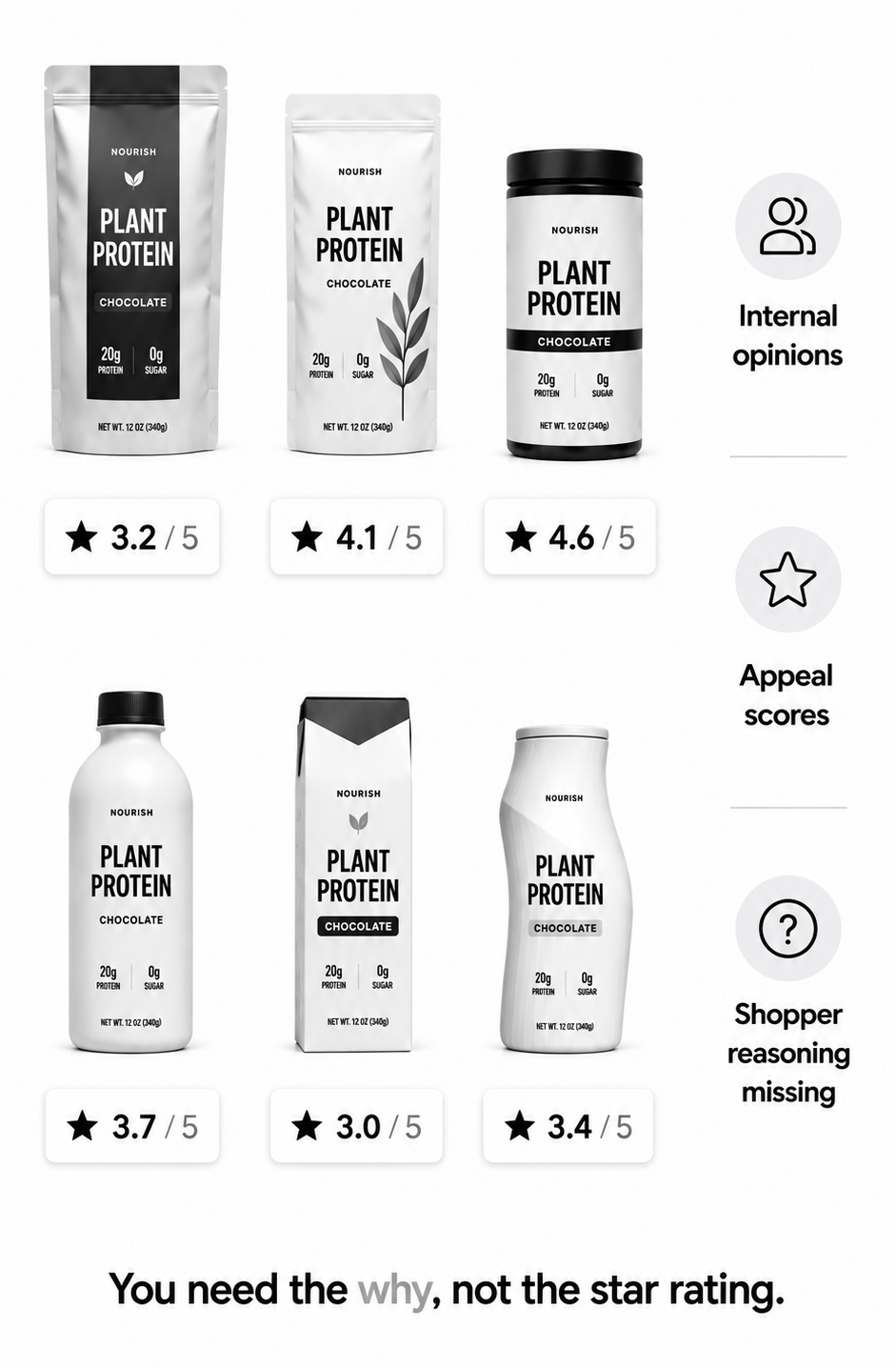
The brand team has six SKUs going to print in three weeks. Marketing wants to test three label variants and a structural redesign. The traditional route is a six-to-eight-week shelf-test study with an agency, a panel vendor, a moderator, and a PowerPoint at the end. So packaging decisions get made the only way they can — on internal opinion, a hallway test, and the loudest voice in the room.
Surveys don't fix it. A 12-question questionnaire on Variant A vs. Variant B tells you which one scored higher on “appeal.” It doesn't tell you the front-of-pack claim hierarchy confused half the shoppers, or that the structural curve reads as premium in one region and cheap in another. You need the why, not the star rating.
What's needed is real shopper conversations — at qualitative depth, but at the speed of a survey, and on a channel the shopper actually uses.
Three things that make it work.
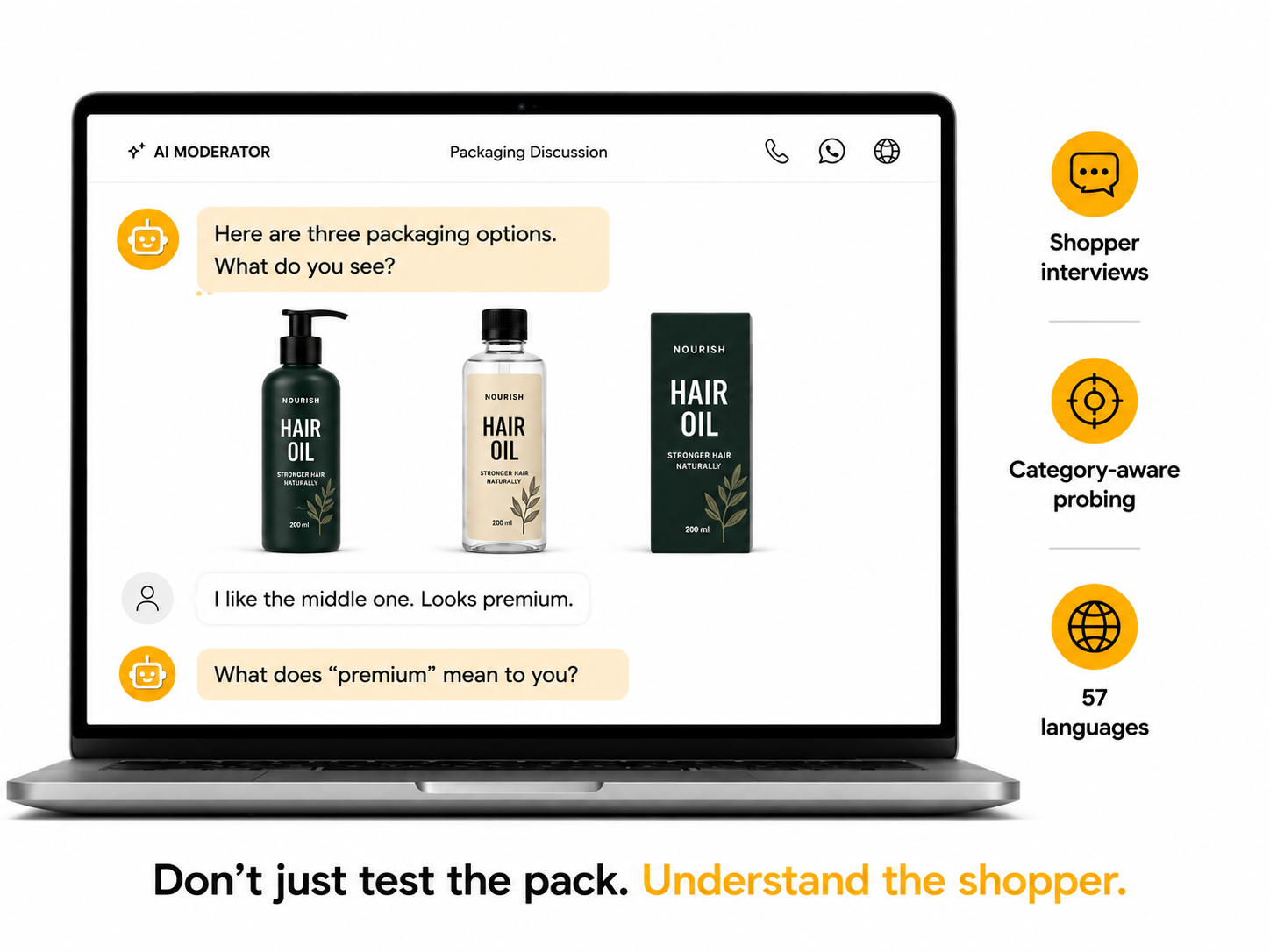
AI moderator that interviews shoppers about your pack.
Upload your packaging variants — labels, mockups, 3D renders, or shelf comps. The AI moderator presents them to recruited shoppers on WhatsApp, web, or phone, asks them what they see, probes when something is unclear, and follows up when a shopper hesitates or contradicts herself. The moderator is trained on your category vocabulary and your prior research, so it knows the difference between a hair oil shopper and a face cream shopper and asks accordingly.
Themes and cited verbatims, not a star rating.
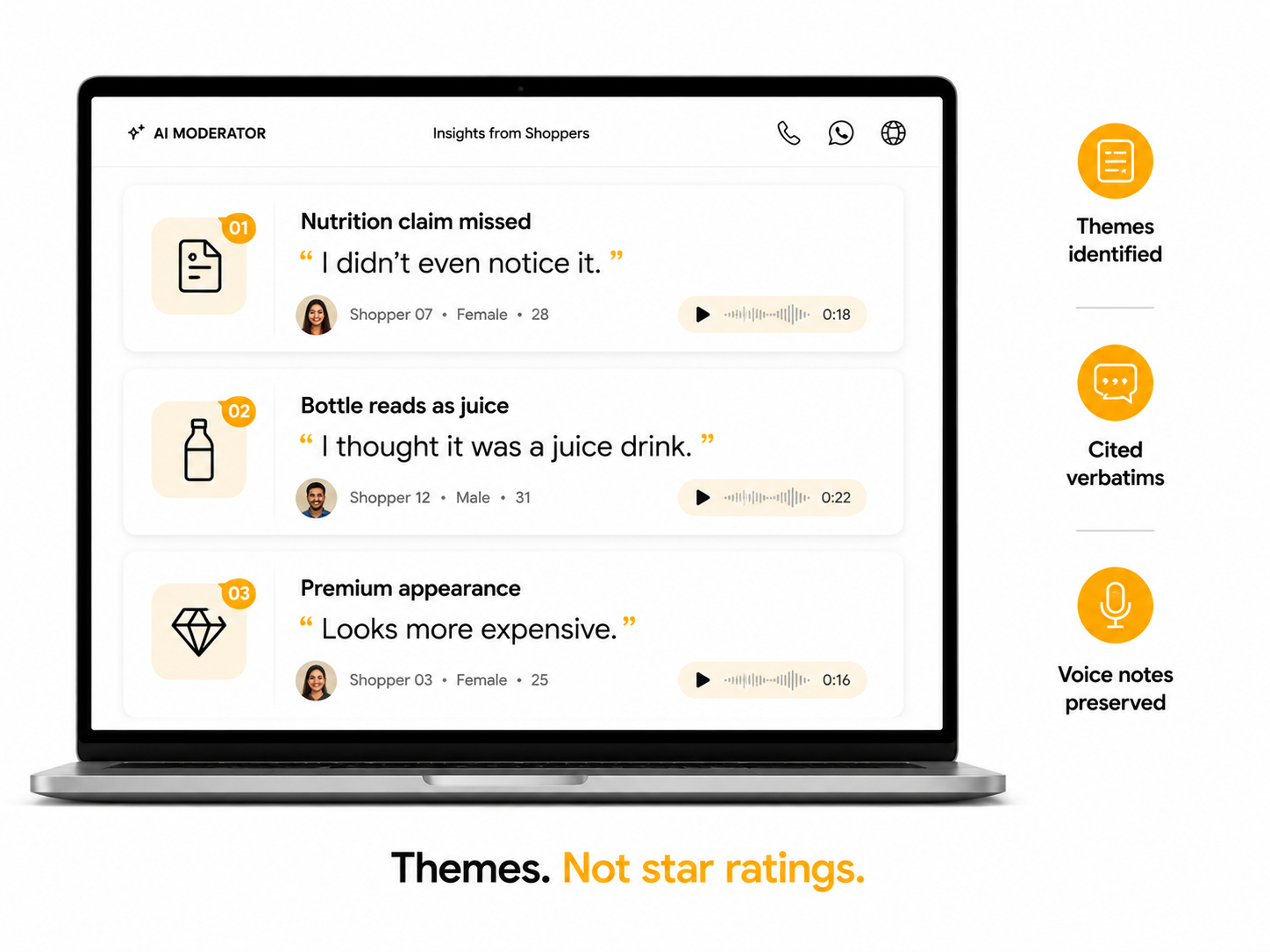
You don't get an aggregate score. You get the actual themes — “Variant B's nutrition claim got missed by most respondents because the green badge fights the brand mark,” “The new bottle shape reads as a juice, not a yogurt, to first-time buyers” — each one cited back to the shopper who said it, with the voice note preserved. Brand teams can hear the hesitation in a respondent's own voice.
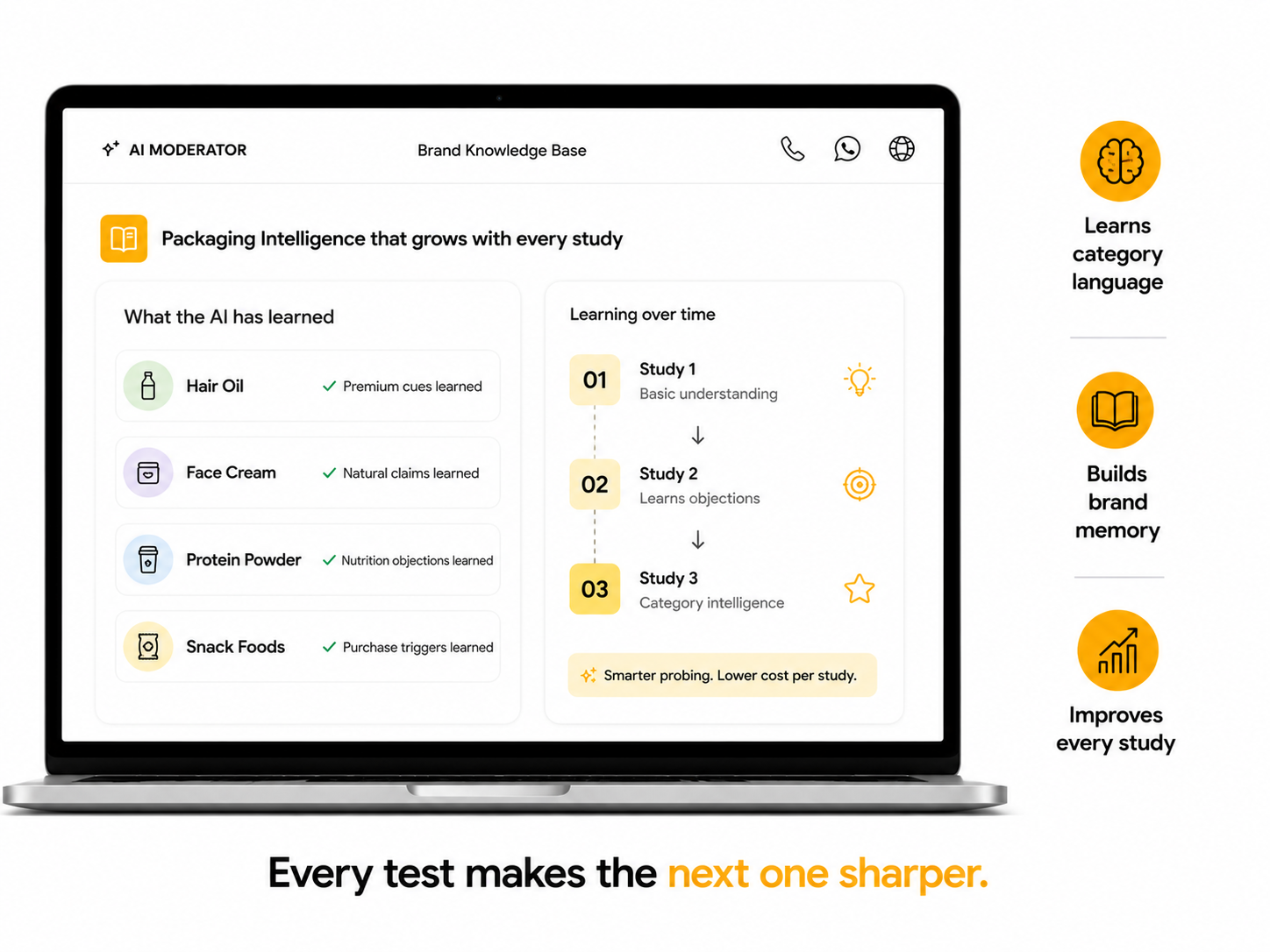
Every test makes the next one sharper.
Each packaging study you run feeds the brand's knowledge base on Alchemic. The moderator learns your category language, your competitor set, your repeat objections. By the third round, the AI knows that “thanda” doesn't always mean cold and that “natural” means different things in oral care vs. snacks. The cost-per-study drops. The quality of probing goes up.
[ the process ]
From upload to themes in three steps.
Step 1
Upload your variants.
Drop in your label files, structural renders, or shelf mockups. Pick the audience — heavy users, lapsed buyers, category entrants, kirana shoppers in Tier 2. Tell the moderator what you want to learn. Setup takes under an hour.
Step 2
Shoppers talk to the AI moderator.
Recruited shoppers receive the study on WhatsApp, web, or phone. They see the packaging, react in their own language, send voice notes. The AI probes when something's unclear — hundreds of interviews running in parallel.
Step 3
Themes with cited verbatims.
Live dashboard fills in as responses come back. The AI clusters reactions into themes — claim hierarchy, shelf standout, structural read, brand cues — and cites every theme back to the shopper who said it. Voice notes preserved. Export anytime.
[ why alchemic ]
What makes this different.
Where your shoppers actually are.
WhatsApp, web, or phone — not just a webcam interview from a quiet home office. The Indian shopper, the kirana shopper, the Tier 2 mom: they're on WhatsApp. Alchemic meets them there in their own language, captures voice notes, transcribes and translates automatically. ListenLabs and Outset don't do this.
Qualitative depth, survey-like speed.
You aren't choosing between a fast survey and a slow qualitative study. The AI moderator runs hundreds of structured conversations in parallel — same probing depth as a human moderator, the speed of a quantitative field. Days, not weeks.
Category-trained moderator that compounds.
Every study you run trains the moderator on your category, your brand language, your shopper segments. Round three is sharper than round one. Most competitors give you a fresh-slate AI on every study; Alchemic gives you a knowledge base that accumulates.
Themes cited back to verbatims and voice notes.
You don't read a synthesised summary. You read a theme, click it, and hear the shopper who said it — in her own voice. Cream-card UI keeps the raw evidence one click from every claim. Brand and insights leads can stress-test the AI's reading themselves.
[ use cases ]
What brands test.
Label and claim hierarchy testing
Find out which claim shoppers see first and which ones never land — across pack variants.
“On this variant, which claim catches your eye first, and what does it tell you about the product?”
Structural and format redesigns
Test new bottle shapes, tube formats, or pouch redesigns against the incumbent before committing to tooling.
“How does this new bottle feel in your hand compared to the one you usually buy?”
On-shelf standout and brand cue testing
Drop variants into a shelf comp and probe what stands out, what gets missed, and which brand cues survive in the wild.
“If you were walking down this aisle at 6 pm after work, which pack would you pick up first, and why?”
Cross-region and language-pair testing
Test the same pack across Tier 1 metros and Tier 2/3 markets, in each shopper's first language, in the same study.
“What does this pack tell you about the brand, in your own words?”
Frequently asked
About this product
What kind of packaging stimuli can I upload?
Flat label artwork, 3D structural renders, shelf comp images, short video walkthroughs of a pack rotation. If you can show it on a phone screen, the moderator can present it and ask about it. Most teams upload PNGs of the front and back of the pack plus one shelf comp.
Can shoppers respond in their own language?
Yes. The AI moderator runs interviews in Hindi, Tamil, Telugu, Kannada, Bengali, Marathi, English, and several others. Shoppers can send voice notes or type. Transcription and translation happen automatically; the moderator probes in the same language the shopper is speaking.
How many shoppers can I talk to in one round?
A typical packaging study runs 50–200 conversations in parallel. Some brands run smaller diagnostic rounds of 20–30; others run 500+ for national rollouts. There's no human moderator bottleneck, so scale is a recruitment question, not a fielding-time question.
How does the AI moderator know my category?
You either upload prior research, brand guidelines, and a competitor brief at setup, or — once you've run a few studies — the platform's already learned your category language from the verbatims of previous rounds. The moderator gets sharper the more studies you run on the same brand.
Can I share the live dashboard with my brand and creative teams?
Yes. The dashboard is link-shareable with role-based access. Brand teams can listen to voice notes directly, click a theme to see every verbatim that supports it, and export evidence to brief the design team without a deck in between.
What's the typical turnaround?
From locked stimulus and audience definition to first themes on the dashboard: typically a few days, depending on recruitment. For pre-recruited panels, it's faster.
About packaging research
What is packaging testing in market research?
Packaging testing is qualitative or quantitative research that evaluates how consumers perceive, understand, and react to a product's packaging — including labels, structural form, claim hierarchy, brand cues, and on-shelf standout. It's typically done before a pack goes to print to reduce the risk of a costly launch failure. Modern packaging testing combines visual stimulus with structured shopper interviews, run online or in-person, to capture both stated preference and the underlying why behind it.
Why does packaging testing matter for FMCG and CPG brands?
Packaging is the single most-seen brand asset a consumer ever encounters — at shelf, in the home, in the hand. A confused claim hierarchy can sink a launch; an unfamiliar structural form can drop trial. For FMCG and CPG brands, packaging is the silent sales rep. Testing it before commitment reduces the risk of expensive reprints, slow shelf turn, and missed first-trial opportunities.
How is AI-moderated packaging research different from traditional methods?
Traditional packaging research runs through in-person focus groups, central-location tests, or scripted shelf simulations — typically taking six to eight weeks per round. AI-moderated packaging research runs as a structured qualitative interview between an AI moderator and a recruited shopper on WhatsApp, web, or phone. The AI probes follow-up questions in real time, transcribes voice notes, and clusters themes automatically. The turnaround compresses from weeks to days, and the cost per round drops significantly.
Can packaging research be done on WhatsApp?
Yes. WhatsApp is one of the most common ways shoppers in India and other emerging markets engage with brands today, and AI-moderated qualitative research platforms can deploy a packaging study as a chat-and-voice-note interview. The shopper sees the packaging image in the chat, reacts in her own language, sends a voice note, and the AI follows up. This is particularly important for reaching shoppers outside Tier 1 metros who rarely sit for webcam interviews.
What does a good packaging study brief include?
A good brief specifies the variants being tested, the decision the study is informing, the shopper segments that matter, the markets and languages, and the open questions — not just 'do they like it' but 'does the claim land, does the structure feel premium, does the brand mark survive.' The clearer the decision, the sharper the moderator's probing.
How many respondents do I need for a packaging study?
For diagnostic qualitative work, 30–50 conversations per variant per segment is a strong base. For directional decisions across multiple variants and markets, 150–250 is typical. AI moderation removes the human bottleneck, so the sample-size question becomes a recruitment-cost question, not a fielding-time question.
Can the same study test packaging and concept together?
Yes. Combining packaging and concept testing in one structured interview is one of the bigger speed advantages of AI-moderated research. You can present the product concept, then the proposed packaging, and probe whether the pack delivers on the concept — all in one shopper conversation, not two sequential studies.
Should I test packaging in shopper's own language?
Almost always, yes. Shoppers describe colour, claims, and structural form differently in their first language than in English. A claim that reads as 'natural' in English can land as 'ordinary' or 'premium' depending on the Indian-language equivalent. Testing in the shopper's own language is the only way to catch this without a human moderator translating in real time.