
Shopper claim tests fielded in the USA, the UK and 12 more markets
Claims Testing for US Consumer Brands Before Launch
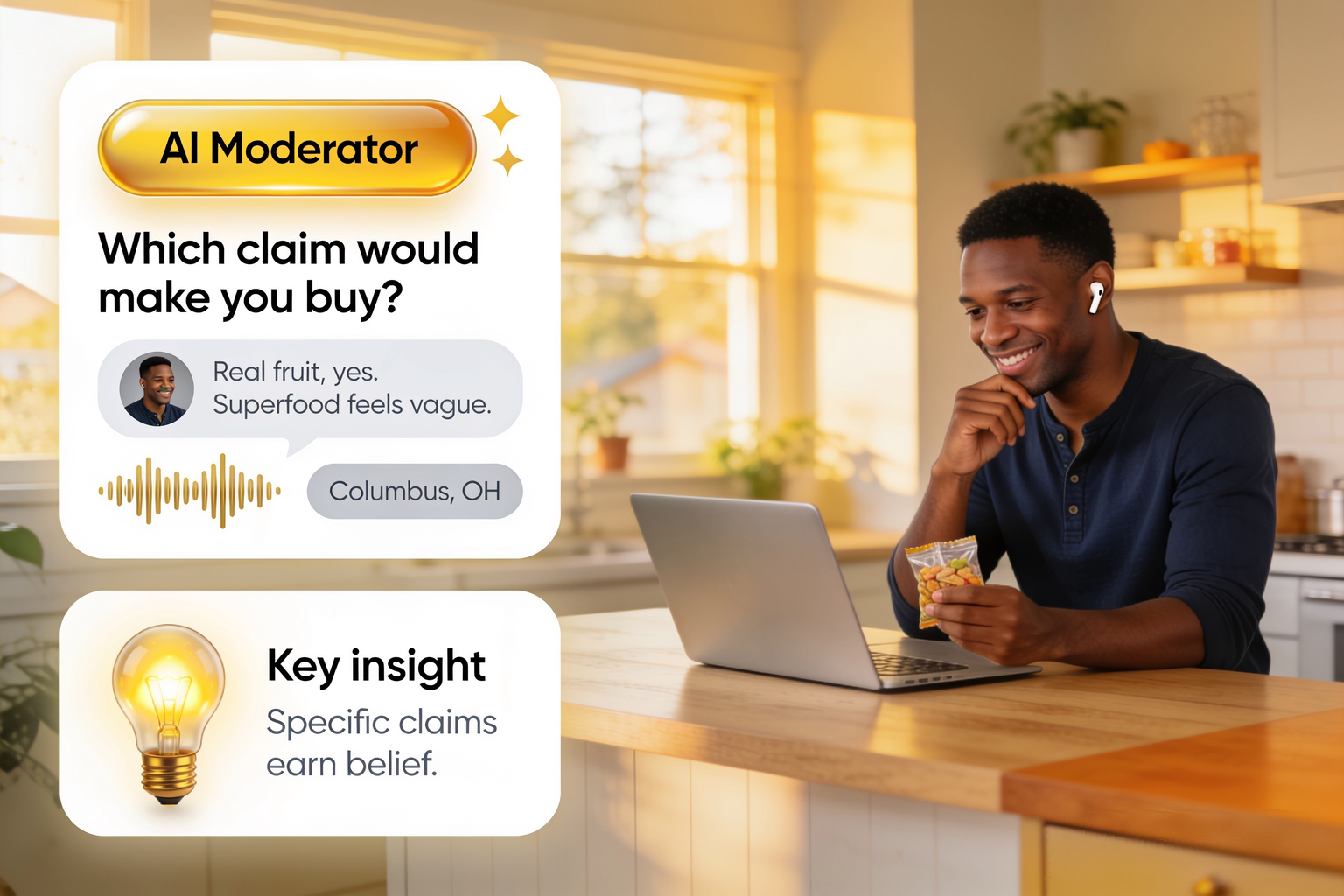
Your US launch has a long list of candidate claims and room on the pack for two, and a survey average will not tell you which one shoppers believe. Alchemic runs claims testing as AI-moderated interviews that show each claim on its own and ask why every rating landed where it did. We test concept claims, pack and label claims and ad claims, so you learn which claim is understood, which is believed and which makes people buy.
Our Claims Testing Services
Each service below uses the same AI moderator: it shows a claim, checks what the shopper thinks it means, then asks how believable and motivating it is and why, with hundreds of interviews running at once.
Claims on the Concept Card
Key claims surface one at a time on an interactive concept card, so shoppers read each claim before rating it, and the AI asks why 3, not 4. Alchemic's stated norm is 100 to 200 interviews per concept.
Explore Concept TestingPack and Label Claims
Find which front-of-pack claim shoppers see first and which never lands, from hair care to snacks. Alchemic's stated diagnostic base is 30 to 50 conversations per variant per segment, each theme cited to the shopper's voice note.
See Packaging TestingClaims Inside Your Advertising
Test a claim in the creative that carries it. Camera-on interviews probe element by element, including the claim line and the call to action, with explicit recording consent and typical studies of 200 to 500 interviews per market.
Learn MorePurchase Intent Behind a Claim
A claim that lifts stated intent may not lift sales. Our sourced guide explains what a top-two-box score on a 5-point scale predicts, why stated intent overstates demand, and why it ranks claims better than it forecasts them.
Read the Intent GuideWhere Claims Fit in a Launch
Claims are best tested once the concept is settled and before the pack prints. Our launch guide puts 7 research stages in order, from need and opportunity to a tracking baseline, with the question each stage cannot answer.
See the Launch SequencePackaging Testing Platforms in the US
Comparing vendors for pack and label claims? Our US guide sets out shelf, monadic and sequential monadic methods, a common 50 to 200 shopper sample, and how to check sample quality before you trust an appeal score.
Compare Platforms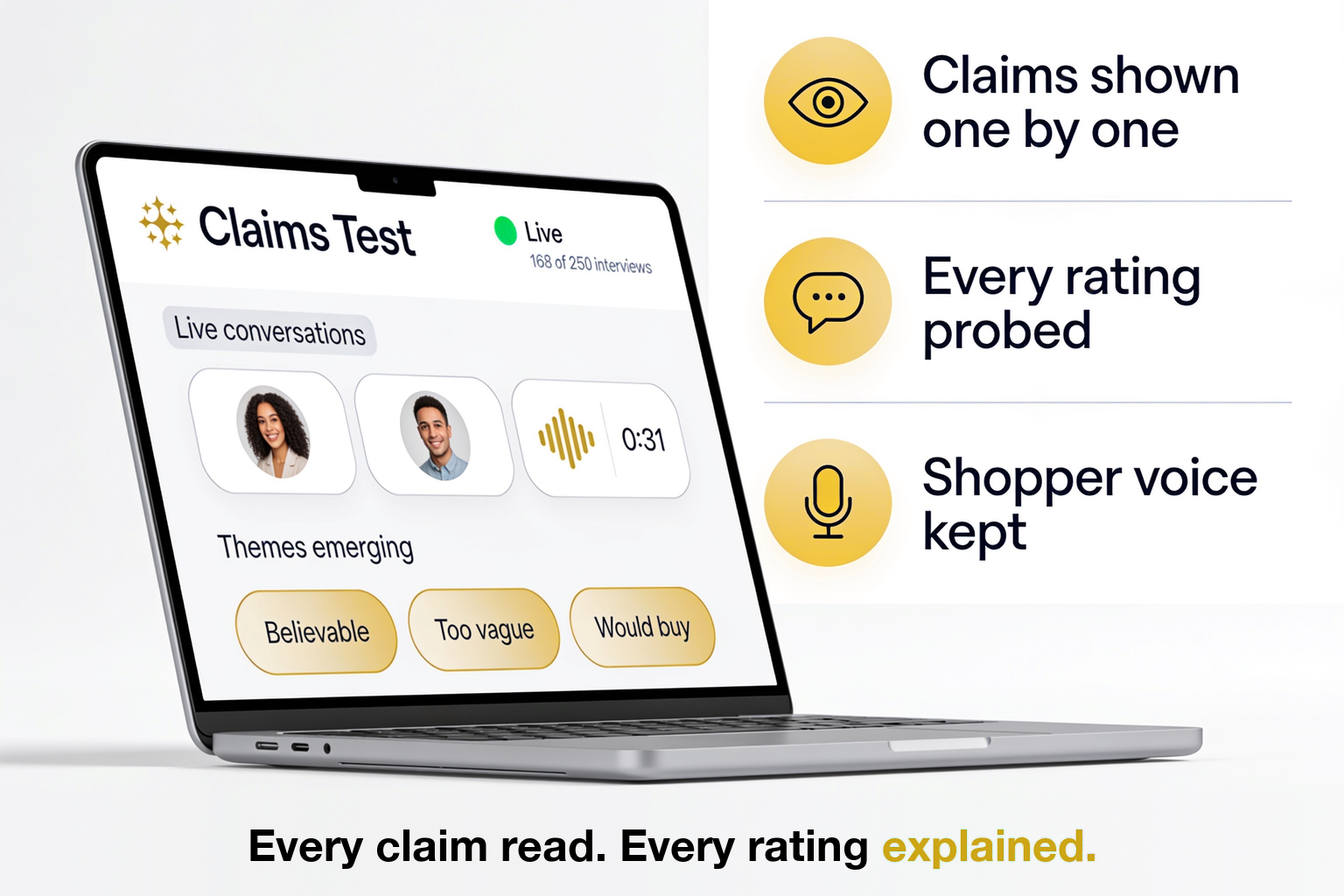
Our 5-Step Product Claims Testing Process
Set the claim shortlist
Build the stimulus and sample
Check meaning, then probe the rating
Read belief and confusion live
Choose the claim on evidence
Honest fit
Claims Testing, Substantiation or a Benchmark Score
Claims testing measures what shoppers make of a claim: whether they understand it, believe it and would act on it. Whether a claim is true and supportable is a different job, claims substantiation, settled through lab, clinical or instrumental testing and legal review, and a perception test never stands in for it. If you need claim scores against a normative benchmark database, the established survey vendors serve that well, and many teams run both. Alchemic's version is the perception read at scale: every claim shown on its own, every rating probed, every finding traced to the shopper and the quote. Pick by the output your decision needs.
Testimonials
Discover what our clients have to say about our consumer research services
Alchemic is ridiculously fast, and getting both qual and quant insights at that speed is a game-changer.

Alchemic's interviews go far deeper than any survey we have ever run and I love being able to pull up user stories for every insight.

Why Alchemic
Why Choose Alchemic for Claims Testing Market Research?
Comprehension before belief
A claim nobody understood cannot be believed. The AI asks what a claim means in the shopper's own words before asking how credible it is, which separates a wording problem from a credibility problem.
American shoppers already interviewed
Alchemic has fielded studies with consumers in the United States and the United Kingdom, among 14 markets in all, so a US claims test is run by a team that already handles American fieldwork.
Each claim read on its own
Claims surface individually on the concept card and the AI tracks engagement before any question is asked, so a shopper who skimmed past a claim is never counted as having rated it.
Every score has a source
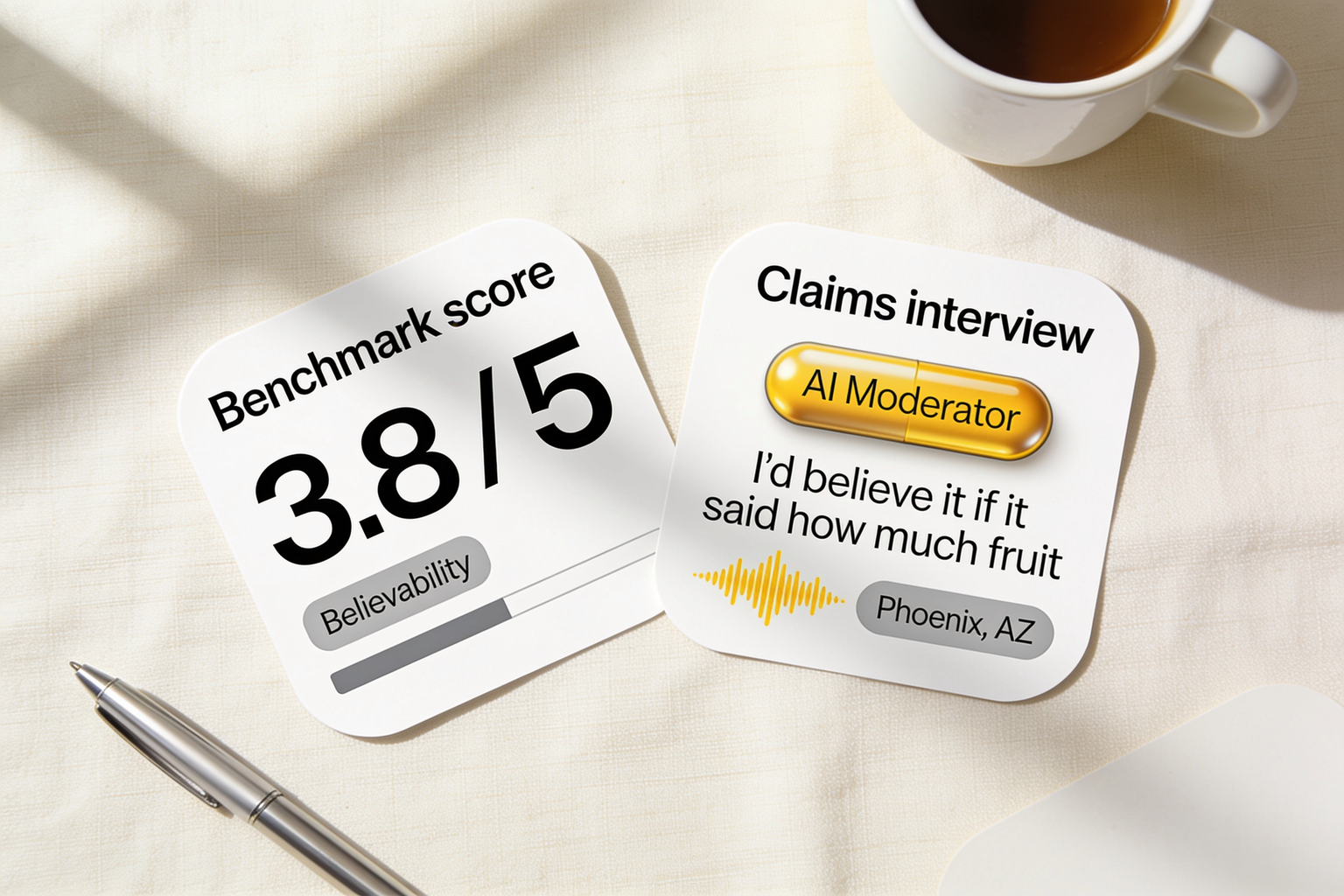
Drill from any claim's score to the shoppers behind it, their verbatim and the voice clip. Brand and design teams hear exactly what consumers took a claim to mean, quote by quote.
About Alchemic
An AI-native research company running end-to-end consumer research at scale, built by researchers.
Alchemic is a founder-led, AI-native research company focused on end-to-end consumer research at scale, with studies fielded in the United States, the United Kingdom and 12 other markets, 14 in all. Its human-briefed AI interviewer holds one-on-one conversations in the browser and by phone in 60+ languages including English, Spanish, French, Arabic and Hindi, and on WhatsApp by text or voice note. Alchemic has run 50,000+ interviews for brand and insights teams in consumer goods, fintech, healthcare, retail and technology, among them Unilever, Mars, Sleepwell and CaratLane. Claims work draws on its concept, packaging and ad testing: the same moderator shows a claim, checks comprehension and probes the rating, and every theme links back to the shopper and the quote. For a US brand team that means a claim chosen on stated reasons rather than a mean score. Studies are quoted per project, with no per-seat fees.
- 50,000+interviews run
- 60+languages, built with native speakers
- 14markets fielded, including the USA and UK
Claims Testing FAQ
What is claims testing?
How does claims testing work?
Is claims testing the same as claims substantiation?
What does product claims testing measure?
Can claims testing cover cosmetic and hair product claims?
How many respondents does claims testing need?
How do you rank a long list of claims?
How long does claims testing take, and what drives the cost?
Still deciding which claims to test?
Send us the claim list and the decision it feeds, and we will tell you which test design fits it and what Alchemic's version would produce.
Plan Your Claims Test With Alchemic
Send the claims you are weighing, the product they belong to and the US shoppers whose belief matters. We come back with a test design, a sample plan and a per-study quote, and you work directly with the founders rather than a sales desk.
Tell us about your claims test
Tell us a bit about yourself and we'll be in touch