

Last updated: 22 September 2026
Quick Answer: Qualitative research explains why people behave as they do, using interviews, observation and other non-numerical data. It works in small purposive samples rather than large ones. A 2017 study in Qualitative Health Research identified the range of thematic issues by the ninth of 25 health interviews, and needed 16 to 24 before those themes were understood in depth.
Qualitative research is the part of a study that produces explanations rather than counts. Suppose checkout conversion falls 15% in a quarter. The dashboard tells you where people leave. It does not tell you whether they balked at the shipping cost, lost confidence at the payment step, or went to compare prices and never came back.
That gap is not a reporting problem, and more dashboards will not close it. The mechanism behind a number lives in what people say, do and hesitate over, which is why the sample sizes look so different from survey work: in one study of 25 in-depth interviews with HIV-positive patients at a US veterans clinic, the range of thematic issues had been identified by the ninth interview, but 16 to 24 were needed before the researchers could say they understood what those themes meant. That is health research with a narrow question, which is where most published saturation evidence comes from.
What Is Qualitative Research?
Qualitative research is a method of inquiry that explores experiences, perceptions and motivations through non-numerical data. It collects words, images, recordings and observed behavior rather than measurements, and analyzes them for patterns of meaning. It answers why and how a behavior happens, not how many people do it.
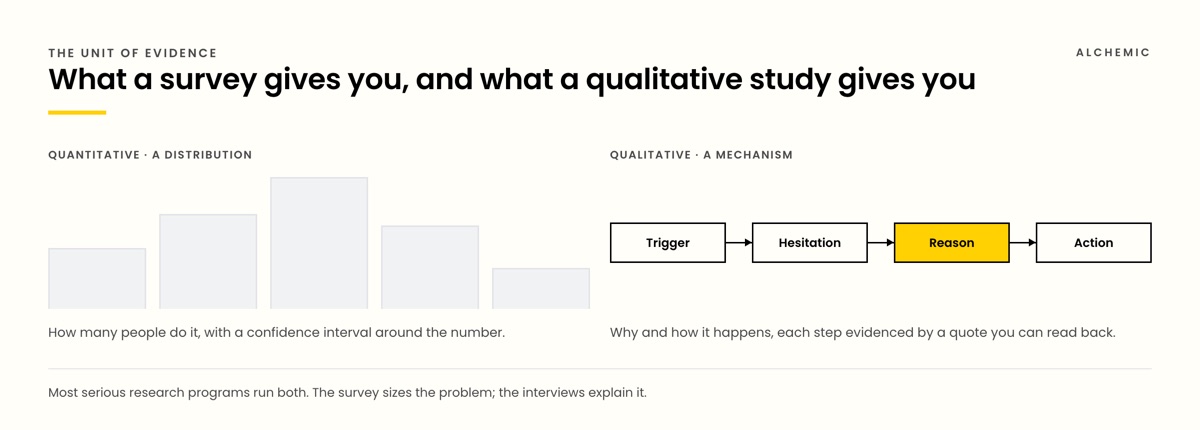
The output is a set of themes, each supported by evidence you can read back: a verbatim quote, a moment in a recording, a field note. Where a survey gives you a distribution, a qualitative study gives you a mechanism.
What Makes Data Qualitative?
Four properties separate qualitative data from survey data, and each one drives a design decision later in the study.
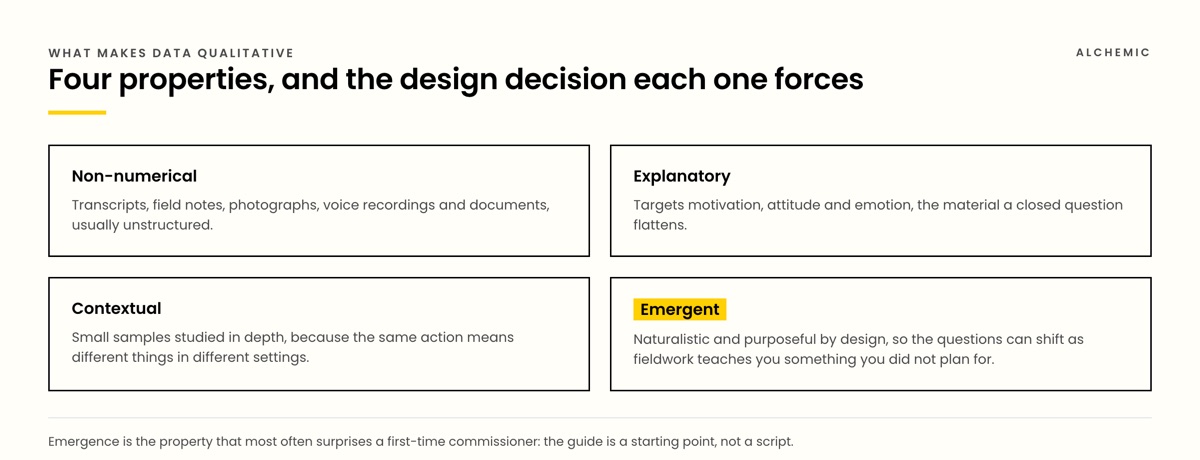
- Non-numerical. Transcripts, field notes, photographs, voice recordings and documents, usually unstructured.
- Explanatory. It targets motivation, attitude and emotion, the material that a closed question flattens.
- Contextual. Small samples studied in depth, because the same action can mean different things in different settings.
- Emergent. The USC Libraries research guide describes qualitative design as naturalistic, emergent and purposeful, meaning the questions can shift as the fieldwork teaches you something you did not plan for.
How Is Qualitative Research Different From Quantitative Research?
Quantitative research measures how much and how many across a large sample. Qualitative research explains why and how across a small one. The practical difference is the unit of evidence: a percentage against a confidence interval on one side, a theme against a quote on the other. Most serious programs run both.
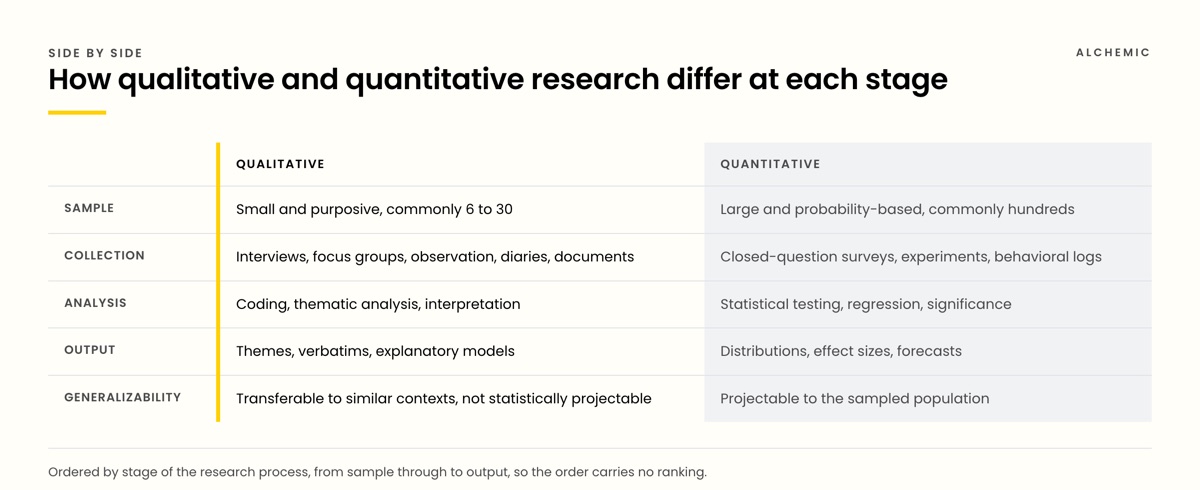
The table below is ordered by stage of the research process, from data through to output, so the order carries no ranking.
| Dimension | Qualitative research | Quantitative research |
|---|---|---|
| Data type | Words, images, recordings, observations | Numbers, scales, counts |
| Question shape | Why? How? What is driving this? | How many? How much? What percentage? |
| Sample | Small and purposive, commonly 6 to 30 | Large and probability-based, commonly hundreds |
| Collection | Interviews, focus groups, observation, diaries, documents | Closed-question surveys, experiments, behavioral logs |
| Analysis | Coding, thematic analysis, interpretation | Statistical testing, regression, significance |
| Output | Themes, verbatims, explanatory models | Distributions, effect sizes, forecasts |
| Generalizability | Transferable to similar contexts, not statistically projectable | Projectable to the sampled population |
The choice of mode is not neutral either. When Pew Research Center randomly assigned 3,003 respondents to a telephone interview or a self-administered web survey, answers differed by an average of 5.5 percentage points across 60 questions, with a median of 5 and a spread of 0 to 18. The largest gaps, 18 and 14 points, were on the quality of family life and social life, where telephone respondents reported higher satisfaction.
What Are the Main Qualitative Research Methods?
Six methods cover most commissioned qualitative work: semi-structured interviews, focus groups, observation, ethnography, open-ended questionnaires and diary studies. They differ in what they capture, not in rigor. Case studies, document analysis and narrative analysis are qualitative too, but they run on records and archives rather than fielded respondents.
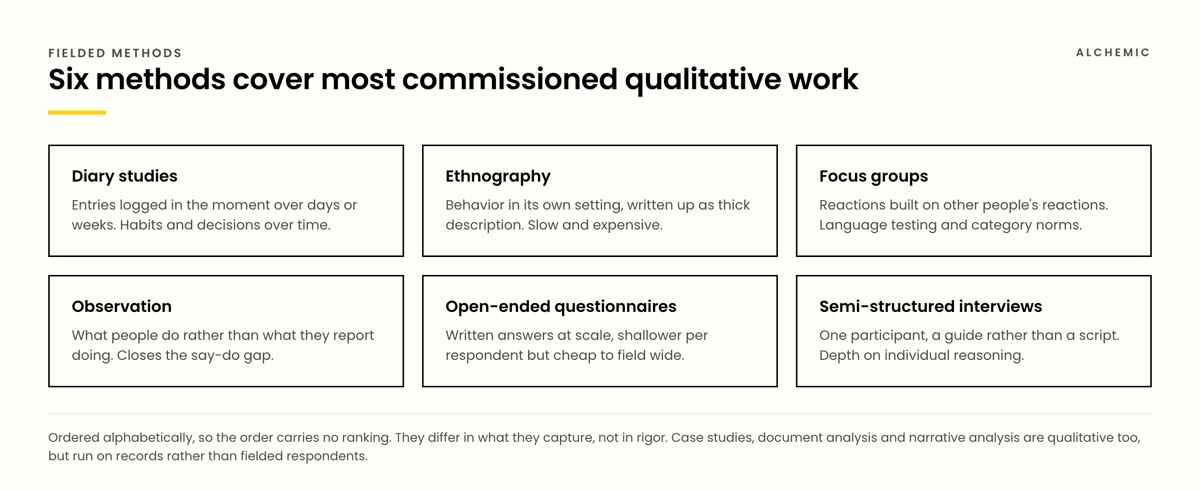
The table is ordered alphabetically by method, so the order carries no ranking.
| Method | What it produces | Best for | Main limitation |
|---|---|---|---|
| Diary studies | Entries logged over days or weeks, in the moment | Habits, routines, decisions spread over time | Drop-off, and entries get thinner as the study runs |
| Ethnography | Deep contextual accounts of behavior in its own setting, written up as thick description | Culture, category norms, unarticulated habits | Slow and expensive; weeks to months |
| Focus groups | Group discussion, reactions built on other people's reactions | Language testing, norms, early concept reaction | Dominant voices and groupthink flatten individual depth |
| Observation | A record of what people actually did, not what they report | Shopper behavior, usability, physical environments | Explains the what, rarely the why, without a follow-up interview |
| Open-ended questionnaires | Written answers in the respondent's own words, at scale | Large-sample texture, screening before depth work | No probing, so a thin answer stays thin |
| Semi-structured interviews | One-to-one depth with probing on whatever surfaces | Motivation, decision journeys, sensitive topics | Cost and time per respondent; interviewer effects |
Diary Studies
Diary studies ask participants to log experiences as they happen, over days or weeks. They catch what memory smooths over: the third coffee nobody reports, the app opened at midnight, logged as text, photo or voice. The trade-off is attrition, so incentives and reminders are part of the design. Platform choices for this method are covered in diary study platforms.
Ethnography
Ethnography studies people in their own environment over an extended period, so that behavior is read in its context rather than in a research setting. It is the most expensive method here and the hardest to shortcut, because the value comes from staying long enough for people to stop performing. Thick description is not the method but the write-up convention it depends on, and the two are worth keeping apart: you can observe well and still report thinly.
Focus Groups
A focus group is a moderated discussion, usually 6 to 12 participants, where the value comes from what the group does to each other: disagreement, correction, and language nobody uses in a one-to-one. That same dynamic is the risk, since one confident participant can steer the room. The case for the method is set out in what focus groups still do best.
Observation
Observation records behavior directly, in a natural or controlled setting, and its strength is the gap it exposes between reported and actual behavior. Participant observation puts the researcher inside the activity; non-participant observation keeps them outside it. The method is set out in qualitative observation.
Open-Ended Questionnaires
Open-ended questionnaires put unstructured questions in front of a large sample and collect answers in the respondent's own words. They scale further than interviews and cost less. What they cannot do is follow up, so question wording carries all the weight. Worked examples are in qualitative questionnaire examples.
Semi-Structured Interviews
Semi-structured interviews are the default method in commercial qualitative research. A guide sets the topics and the probes; the order and the follow-ups move with the respondent. That flexibility is what surfaces contradictions between what someone says early and what they admit later. The format is covered in semi-structured interviews.
How Do You Conduct Qualitative Research Step by Step?
Eight steps take a qualitative study from a business question to a decision: define the question, choose the sample, design the study, recruit and consent, collect, code, interpret, and report. The order matters because each step constrains the next, and sampling decisions made badly cannot be repaired in analysis.
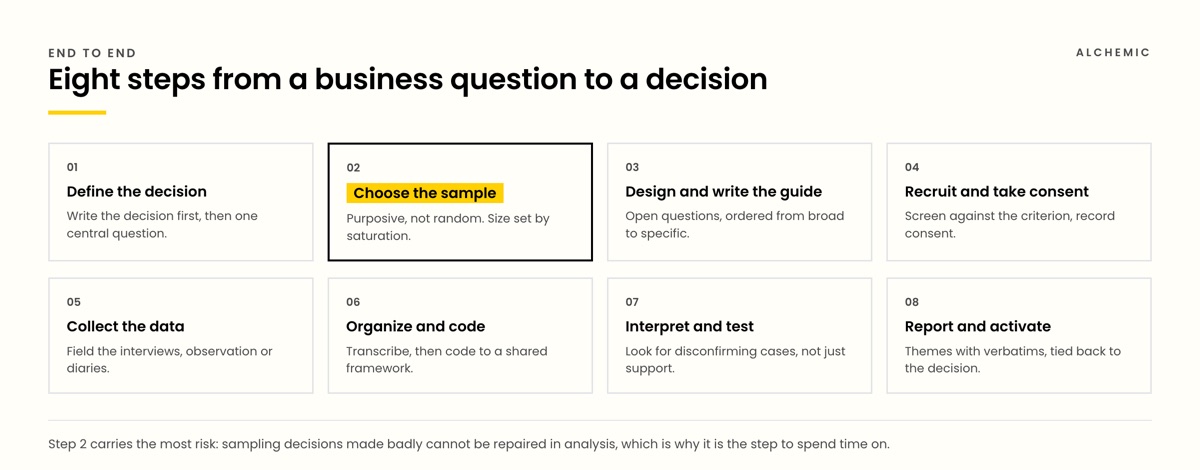
Step 1: Define the Decision the Research Has to Inform
Write the decision first, then the research question. One central question, specific but not narrow: why do customers abandon the cart at the payment step, not why do customers behave the way they do. A study that tries to answer three unrelated questions answers none of them well.
Step 2: Choose the Sample and the Number of Interviews
Qualitative sampling is purposive: you select information-rich cases, not a random draw. Snowball, quota and convenience sampling all have their place, with convenience the weakest. Sample size is then set by saturation, and the published numbers are smaller than most buyers expect.
The table is ordered by number of interviews, smallest first. Every row comes from health research answering a narrow question, so read the numbers as planning norms for a tightly scoped commercial brief, not as a floor for a broad consumer category.
| What you are trying to reach | Interviews reported | Evidence |
|---|---|---|
| New information down to 5% or less | 6 homogeneous, 8 to 9 more varied (medians) | PLOS ONE bootstrapping study, 2020 |
| The range of thematic issues, called code saturation | 9 | Qualitative Health Research, 2017 |
| No new themes at all | 11 homogeneous, 12 more varied (medians) | PLOS ONE bootstrapping study, 2020 |
| Rich understanding of themes, called meaning saturation | 16 to 24 | Qualitative Health Research, 2017 |
| Meta-themes across several countries or sites | 20 to 40 | Hagaman and Wutich, cited in PLOS ONE, 2020 |
The PLOS ONE team bootstrapped three coded datasets and reported medians rather than a single number. At a run length of two interviews, the median was 6 before new information fell to 5% or less of what the first interviews produced, and 11 before no new themes appeared at all, in two homogeneous datasets; a more varied dataset needed 8 to 9 and 12. A 2022 systematic review of health research in Social Science and Medicine put the empirical range at 9 to 17 interviews, or 4 to 8 focus group discussions, for relatively homogeneous populations and narrowly defined objectives.
Step 3: Design the Study and Write the Guide
Design is where the method is matched to the question and the instrument is written: a discussion guide for interviews, a moderator guide for groups, an observation protocol, a coding frame. Treat design as five linked components, goals, conceptual framework, research questions, methods and validity, rather than a sequence. Structural choices are covered in qualitative research design.
Step 4: Recruit Participants and Take Consent
Recruit from your own customer base, a panel, communities or referrals, and pay people for their time. Consent is not paperwork: explain the purpose, the data use, the retention period and the right to withdraw. The ICC/ESOMAR International Code, revised in 2025 and recognized by over 60 associations in more than 50 countries, is the operative standard, alongside your own legal basis for processing.
Step 5: Collect the Data
Good collection is mostly restraint. Open wide, probe narrow, stay neutral, and follow the tangent that was not in the guide. Record everything with permission. The moderator can be a person or, in AI-moderated interviews across text, voice and video, a trained system that probes on a low rating or a contradiction and keeps the same protocol across every respondent.
Step 6: Organize, Transcribe and Code
Transcribe, name files consistently, back up, then read everything once before coding anything. Build a codebook, apply it systematically, and group codes into themes. Double-coding a share of the transcripts is standard practice, and one common protocol checks intercoder reliability on 20% of interviews. Tooling options are compared in qualitative data analysis software.
Step 7: Interpret and Test the Findings
Interpretation is where a theme becomes a finding, and it is also where a study goes wrong. Actively hunt disconfirming evidence: look for the transcripts that contradict your emerging story and report them. Member checking, taking the interpretation back to participants, strengthens credibility. The UK government publishes a Quality in Qualitative Evaluation framework for exactly this appraisal step.
Step 8: Report and Activate
Write for the decision, not for the method. An executive needs the implication in one page; a product team needs the specific friction and the verbatim behind it; a researcher needs the sampling and coding detail to judge the work. Evidence clips, quotes and short video highlights travel further inside an organization than a slide summarizing them.
What Does Qualitative Research Change in a Business Decision?
Qualitative research changes decisions by replacing an assumed cause with an observed one. A dashboard narrows a problem to mobile users on iOS in the evening; interviews tell you the checkout control is mis-tapped on small screens, which is a fix rather than a hypothesis.
Reach for it when you are entering a category you do not know, when a number moved and nobody can explain it, when you need the words customers actually use, or when you are generating hypotheses that a survey will later size. The broader case is set out in the advantages of qualitative research.
It also protects against a specific failure: research that confirms what the team already believed. A well-run qualitative study produces at least one finding the commissioning team did not want, and a report with no uncomfortable finding in it deserves a second look.
Which Respondents Does a Browser Link Miss?
A qualitative study distributed as a browser link reaches people who have a smartphone, a data connection, the patience for a landing page and enough literacy in the interface language to complete a session. Everyone else is quietly excluded, and the exclusion is systematic rather than random, which is what makes it a sampling problem rather than a nuisance.
The scale is easy to underestimate. ITU's Facts and Figures 2025 edition reports that 2.2 billion people remain offline, most of them in low and middle income countries. Even in the United States, Pew Research Center's November 2025 fact sheet records that 98% of adults own a cellphone while 91% own a smartphone, so roughly one adult in fourteen carries a phone that will not run a browser-based interview session well.
The fix is to let the respondent pick the channel. Alchemic runs interviews natively inside WhatsApp, with no link and no app, alongside outbound AI phone interviews to any working number, feature phones included, and the messaging route is set out in how WhatsApp interviews are run. Voice notes are qualitative data in their own right, not a downgrade from typed answers, and the handling they need is covered in voice notes as qualitative data.
What Qualitative Research Cannot Settle
Qualitative research cannot tell you how many. It has no confidence interval, no margin of error and no claim on the population, because purposive samples are not built to project. Its findings are transferable to similar contexts, a weaker claim than statistically generalizable.
Transferability rests entirely on how richly the setting was described, which is the argument in thick description in qualitative research. Treating a theme as a market share is the most common misuse.
Three limits follow from that. It cannot size a market or settle a pricing decision on its own. It cannot resolve a dispute about which of two creative executions performs better, because that is a between-group comparison and needs a powered sample. And it cannot rule out interviewer and mode effects, which Pew measured at up to 18 percentage points between telephone and web in a single experiment.
So there are decisions where a different approach simply wins. If the question is how many or how much, a survey with a properly powered sample is the right spend and a qualitative study is the wrong one. If you need to watch someone use a physical product in their own kitchen, an in-person ethnographic visit beats any remote interview, whoever or whatever moderates it.
Where Is Qualitative Research Heading in 2026?
The direction of travel is toward continuous qualitative work at larger sample sizes, with automation taking the mechanical load and researchers keeping the interpretive one. Fieldwork that once ran as a quarterly project now runs as a standing capability, and reporting follows the same cadence.
Four shifts are doing the work. Moderation and transcription are increasingly automated, which changes the cost of an extra ten interviews from prohibitive to marginal. Fieldwork is remote by default, so geography no longer caps who is in the sample. Analysis starts during collection rather than after it. And qualitative and quantitative data increasingly sit in one study, so the distribution and the reason for it arrive together. Alchemic publishes 57+ languages including Hindi, Tamil and Telugu, with managed fieldwork or bring your own recruitment across 14 markets including the USA and the UK.
The governance is catching up faster than most teams realize. The AAPOR Code now states explicitly that responses generated through artificial intelligence are not research participants, and that any such cases included in a study of public opinion must be identified as AI-created. Automated coding sits in the same territory, and the disclosure question is the same one: who checked the second pass, and against what. Provenance of the coding belongs in the method note beside provenance of the sample.