

Last updated: 7 October 2026
Quick Answer: A matrix question is a survey grid that asks respondents to rate several items, listed as rows, on one shared answer scale shown as columns. It saves space when items share a scale, but long grids invite straightlining. The US Census Bureau's 2026 web survey guidelines note grids are faster than item-by-item questions yet render poorly on phones.
A matrix question is a compact way to ask the same kind of question about several things at once. Instead of five separate satisfaction questions, you get one grid with five rows and one row of answer options across the top.
That compactness is the appeal and the risk. A grid is quick to build and quick to answer, which is exactly why tired respondents can race down it, and why it misbehaves on a small screen.
How Is a Survey Grid Laid Out?
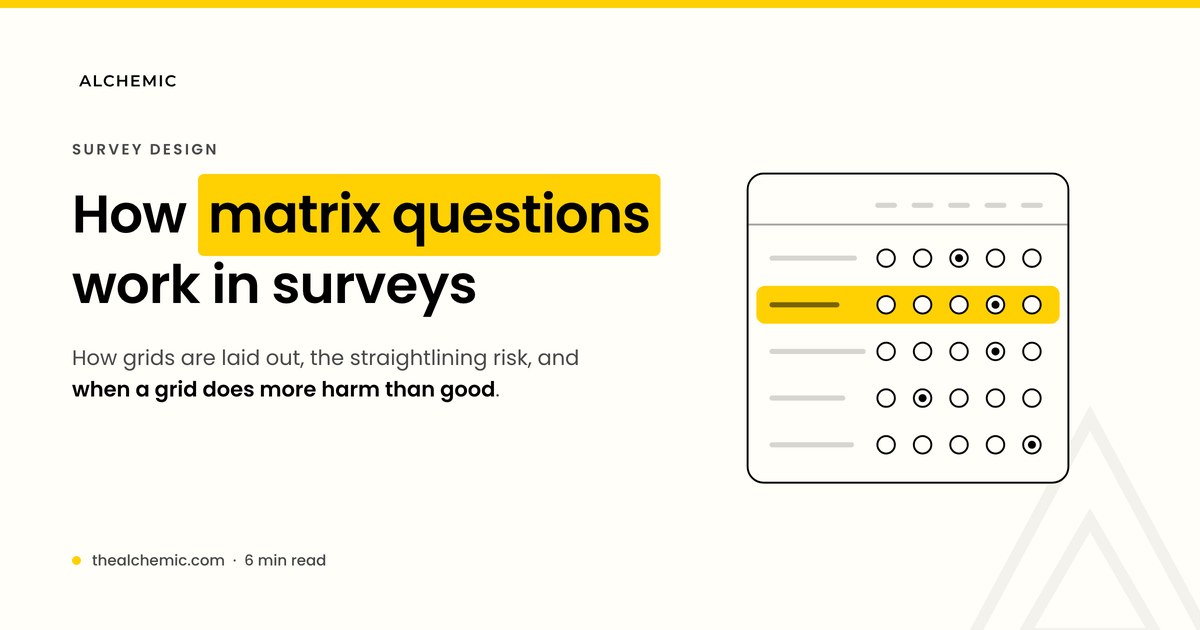
A matrix question lists items down the left as rows and a shared answer scale across the top as columns, one answer per row. Most matrix questions use a rating scale, such as satisfaction or agreement, and are sometimes called matrix table questions.
Here is a matrix question example for a delivery app, shown as the respondent would see it:
| How satisfied are you with... | Very dissatisfied | Dissatisfied | Neutral | Satisfied | Very satisfied |
|---|---|---|---|---|---|
| Delivery speed | ○ | ○ | ○ | ○ | ○ |
| Order accuracy | ○ | ○ | ○ | ○ | ○ |
| App ease of use | ○ | ○ | ○ | ○ | ○ |
| Customer support | ○ | ○ | ○ | ○ | ○ |
| Price | ○ | ○ | ○ | ○ | ○ |
Grids also come in other forms. A yes/no grid asks whether each statement applies, a frequency grid uses never to always, and a checkbox grid lets people tick more than one column per row.
When Should You Use a Matrix Question?
Use a matrix survey question when several items are closely related, share exactly the same answer scale, and number only a handful. It works best for short attribute batteries on desktop screens, such as rating five parts of one service, where the grid saves space without hiding meaning.
Good uses share four traits:
- Same scale: Every row is answered with identical options.
- Same topic: Rows belong together, such as parts of one experience.
- Short list: A handful of rows, not a wall of twenty.
- Comparison matters: Seeing rows side by side helps people rate them relative to one another.
What Is Straightlining in Matrix Questions?
Straightlining is when a respondent picks the same answer for every row in a grid, a sign they may have stopped reading. The American Association for Public Opinion Research (AAPOR) lists it among the quality problems of online panels in its 2010 report, as low differentiation across a grid's items.
Not every straight line is careless; someone may truly feel the same about everything. But long grids make the shortcut tempting. The US Census Bureau's web survey guidelines note that practitioners caution grids are among the hardest question formats to answer and may lead to non-differentiation of responses.
Gentle prompts help. In six web survey experiments, Frederick Conrad and colleagues showed respondents a message to slow down when they answered implausibly fast. Speeding fell, later straightlining dropped in one experiment, and breakoffs did not noticeably rise.
Are Survey Grid Questions Worse on Mobile?
Survey grid questions are often worse on mobile, because a wide grid either forces people to zoom and scroll sideways or is collapsed into separate questions. The US Census Bureau's Design Guidelines for Web Surveys and Censuses, version 1.10 from April 2026, documents these trade-offs.
For a series of yes/no items, the guidelines report:
- Grid format: Concise and faster, but with significantly higher nonresponse, as people skip the "No" column, and fewer affirmative answers.
- Item-by-item format: More complete answers, but significantly more breakoffs.
- Time: No notable difference in completion time between the two.
The practical answer is to test both on the devices your audience actually uses, rather than assuming the desktop grid will survive the phone.
How Do You Design a Better Matrix Question?
You design a better matrix question by keeping it short, labeling every column, and making each row easy to tell apart. A grid should look like one simple task, not a spreadsheet.
A short checklist:
- Cap the rows: Split long batteries into two or more short grids.
- Label every column: Words, not just numbers, on each answer option.
- Randomize rows: Order effects then average out across respondents.
- Separate "Not applicable": Place it apart from the scale so it is not read as a rating.
- Add one attention check: A row such as "Please select Agree for this item."
Wording still matters inside a grid. Each row needs the same care as a standalone question, which the guide to biased survey questions covers.
How Should Grid Answers Be Analyzed?
To analyze matrix question data, treat each row as its own question first: chart the distribution for every row, then compare rows by their top-two-box shares or medians. Only combine rows into an index when they measure one underlying idea.
Two extra checks are worth running. Flag respondents who gave identical answers across every row of a long grid, then look at their other answers before deciding whether to keep them. And compare early rows with late ones, since answers can drift as attention fades.
Which Respondents Struggle Most With Grids?
Respondents on small screens, people with limited reading time and those less used to long questionnaires struggle most with grids. A grid assumes a wide screen and steady attention, and it penalizes anyone without both. That is not a small group: Pew Research Center finds 16% of US adults are smartphone-only internet users, with no home broadband.
Asking one item at a time removes the grid entirely. WhatsApp-native interviews put each item in a chat, with no link and no app, and AI phone interviews ask each row aloud. Alchemic's interviews also flag inconsistent and straight-lined responses within an interview as a quality check, and the guide to sample validity covers that screening in more depth.
When Do Grids Do More Harm Than Good?
Avoid a matrix question when rows need different answer scales, when the list is long, when the topic is sensitive, or when most of your audience answers on phones. In each case, separate questions give cleaner data, even if the survey looks longer.
Once it has the client's brief, Alchemic designs and tailors the discussion guide to handle these risks before fielding, rather than leaving that work to the buyer. For a short desktop survey of an engaged panel rating five features, a standard grid in any survey tool remains the fastest choice.