
Your conversion rate drops 15% quarter-over-quarter. The dashboard shows customers are abandoning their carts at checkout. The numbers tell you what is happening. They’re precise, measurable, undeniable.
They also tell you absolutely nothing about why it’s happening.
Are customers balking at shipping costs? Confused by the checkout flow? Distracted by something unrelated to your site? Comparison shopping? Changed their minds about needing the product? The quantitative data is silent on the mechanism. It shows the symptom, not the disease.
This is where qualitative research becomes essential, and why organizations that treat it as optional are operating with only half the information they need.
Why Qualitative Research Matters
Numbers don’t tell the whole story.
In our data-obsessed world, it’s tempting to believe that enough metrics can answer every question. Track enough KPIs, build enough dashboards, measure enough conversion funnels, and surely the answers will emerge from the numbers alone.
Consider that 15% drop in conversion rate. Quantitative analysis might segment it: the drop is concentrated in mobile users, particularly on iOS, mostly in the evening hours. You’ve narrowed the problem. You still don’t understand it.
Qualitative research would uncover that your mobile checkout flow has a subtle UX bug that only manifests on iOS devices. Evening shoppers, who are multitasking while ‘watching’ TV, notice it more because they’re less tolerant of friction.
The numbers never tell you these things. People do.
What is Qualitative Research?
Qualitative research is a methodology that explores and provides deeper insights into human experiences, perceptions, motivations, and behaviors through non-numerical data collection and analysis. It focuses on the “why” and “how” rather than “how many.” It’s exploratory and descriptive by nature, generating rich, detailed, contextual understanding that numbers alone cannot provide.
Think of it this way: quantitative research tells you that 73% of users abandon your app within the first week. Qualitative research tells you it’s because your onboarding flow assumes knowledge that new users don’t have, and they feel stupid rather than empowered when they can’t figure out basic features. One describes the outcome. The other explains the mechanism and points toward the solution.
Key Characteristics of Qualitative Research
There are a few characteristics of qualitative research so you can easily distinguish it from quantitative.

Non-Numerical Data
Qualitative research deals with words, meanings, images, symbols, and testimonials. It collects quotes, narratives, observations, and stories. The data comes in the form of interview transcripts, field notes, videos, and documents, what researchers call “unstructured data”.
Explanatory Nature
This is research that answers “why” questions that numbers can’t address. It explores motivations behind behaviors, uncovers attitudes and beliefs, captures emotions and feelings. It’s particularly powerful in social research where human complexity defies simple measurement.
Contextual and Depth-Focused
Qualitative research studies smaller samples in greater depth than quantitative approaches. It captures nuance and complexity. Context matters as much as content because the same behavior can mean entirely different things in different situations.
Flexible and Adaptive
Research questions can evolve during the study as new insights emerge. Methods adjust based on what you’re learning. The process is iterative rather than linear. Good qualitative researchers pursue unexpected findings rather than rigidly adhering to predetermined questions.
Qualitative Research Is NOT a replacement for quantitative research. It’s complementary.
Qualitative vs. Quantitative Research: Understanding the Differences
The research industry has spent decades forcing a false choice between qualitative and quantitative approaches. Understanding the actual differences matters not so you can choose one, but so you understand when and how to use each, or better yet, both together.

| Qualitative Research | Quantitative Research | |
| Data Type | Non-numerical (words, images, observations) | Numerical (statistics, measurements) |
| Research Questions | Why? How? What motivates? | How many? How much? What percentage? |
| Sample Size | Small, in-depth (often 10-50 participants) | Large, breadth (often 100s-1000s) |
| Data Collection | Interviews, focus groups, observations, document analysis | Surveys with closed questions, polls, experiments |
| Analysis Approach | Thematic analysis, coding, interpretation | Statistical analysis, regression, correlation |
| Objective | Understand meaning, explore phenomena | Test hypotheses, measure relationships |
| Flexibility | Flexible, can adapt during research | Structured, predetermined |
| Generalizability | Not statistically generalizable, transferable insights | Statistically generalizable to population |
| Outcome | Rich descriptions, theories, themes | Numbers, statistical relationships, predictions |
Use qualitative research when:
- You’re exploring new topics with little existing knowledge
- You need to understand motivations, attitudes, or perceptions
- You’re generating hypotheses for later testing
- Context and depth matter more than breadth
- You need direct quotes and stories to illustrate findings
Types of Qualitative Research Methods
Multiple methods exist for qualitative research, each with unique strengths and applications.
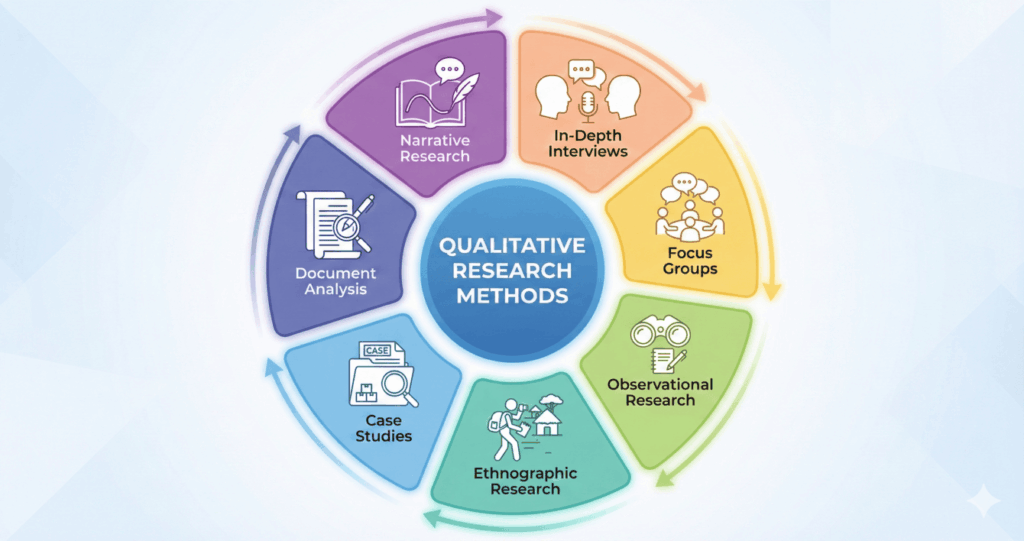
1. In-Depth Interviews
Description: One-on-one conversations between researcher and participant, varying from highly structured (same questions for everyone) to semi-structured (flexible guide) to completely unstructured (open conversation). AI-moderated interviews can now conduct hundreds of these conversations simultaneously.
Strengths: Deep insights, direct quotes, flexibility, and increasingly, scalability through AI-moderated approaches.
When to use: Understanding individual experiences, motivations, and decision-making processes.
Example: Interviewing users who abandoned shopping carts to understand their reasoning.
2. Focus Groups
Description: Facilitated discussion with 6-12 participants exploring a topic through group dynamics.
Strengths: Diverse perspectives, immediate reactions, group dynamics that surface ideas individuals might not mention alone, cost-effective for gathering multiple viewpoints.
When to use: Brainstorming, concept testing, understanding group norms and social dynamics.
Example: Testing new brand messaging with target audience groups to see how language resonates.
Limitations: Groupthink, dominant participants, less individual depth.
3. Observational Research
Description: Watching participants in natural or controlled settings to understand actual behavior rather than self-reported behavior.
Types: Participant observation (researcher involved in the activity) versus non-participant observation (researcher watches from outside).
Strengths: Captures what people actually do, not what they say they do. Reveals unconscious actions and habits.
When to use: Understanding user behavior, usability testing, ethnographic studies.
Example: Observing how shoppers navigate a physical store layout, which paths they take, where they pause, what catches attention.
4. Ethnographic Research
Description: Immersive IRL or digital study of people in their natural environment, with the researcher becoming part of the community being studied.
Strengths: Deep cultural understanding, contextual insights that emerge only over time, holistic view of how factors interact.
When to use: Understanding cultures, communities, workplace dynamics, long-term behavior patterns.
Example: Living with target users for weeks to understand daily product usage in natural context.
Duration: Can last weeks, months, or even years.
5. Case Studies
Description: In-depth examination of a single instance, event, organization, or phenomenon using multiple data sources.
Approach: Combines interviews, documents, observations, and other sources for comprehensive understanding.
Strengths: Comprehensive view, real-world context, detailed analysis of complex situations.
When to use: Understanding complex situations, exploring unique cases, learning from specific examples.
Example: How a specific company successfully implemented customer research practices across the organization.
6. Document Analysis
Description: Reviewing existing documents, records, and artifacts to understand patterns and contexts.
Types: Historical documents, organizational records, social media posts, customer reviews, support tickets.
Strengths: Non-intrusive, cost-effective, reveals patterns over time, provides context for other research.
When to use: Historical research, trend analysis, supplementing other methods.
Example: Analyzing customer support tickets to identify recurring pain points before designing interview questions.
7. Narrative Research
Description: Analyzing how people tell their stories and assign meaning to experiences, focusing on sequence, storytelling patterns, and personal meaning-making.
Sources: Autobiographies, interviews, journals, letters, oral histories.
When to use: Understanding life experiences, patient journeys, career paths, how relationships evolve.
Example: How customers’ relationships with a brand evolve over time, from discovery through loyalty or abandonment.
How to Conduct Qualitative Research: Step-by-Step Process
Well-designed qualitative research requires a systematic approach.

Step 1: Define Research Objectives and Questions
Clarify your goals: What are you trying to understand? Why is this research important? What decisions will it inform? Who needs the insights?
Formulate research questions: Your central research question should sum up the overall goal. Keep it specific but not too narrow. Example: “Why do customers abandon their shopping carts at checkout?” Avoid trying to answer multiple unrelated questions in a single study.
Step 2: Identify Target Population and Sampling Strategy
Determine who to study: Who has the experience or knowledge you need? What characteristics define your population of interest? How will you identify and reach them?
Choose sampling method: Purposeful sampling (deliberately selecting information-rich cases), snowball sampling (participants refer others), quota sampling (ensuring representation of specific groups), or convenience sampling (accessible participants, though less rigorous).
Sample size considerations: Qualitative research used to use smaller samples than quantitative, around 30 participants. With AI assisted interviews, there is no limit. The 187th customer might provide a category-changing perspective.
Step 3: Select Research Methods and Design Study
Choose appropriate methods based on your research question. Match method to objectives while considering practical constraints like time, budget, and participant access. Multiple methods can strengthen findings through triangulation.
Develop research instruments: discussion guides for interviews, moderator guides for focus groups, observation protocols for ethnographic work, coding frameworks for document analysis.
Step 4: Recruit Participants and Obtain Consent
Recruitment strategies: Use existing customer databases, social media and online communities, professional recruitment agencies, snowball referrals, or incentive-based recruitment (compensate people for their time).
Ethical considerations: Always obtain informed consent. Explain how data will be used. Ensure confidentiality or anonymity. Give participants the right to withdraw at any time. Get approval from ethics review boards if required.
Step 5: Collect Data
During data collection: The interviewer, human or AI, should build rapport with participants. Listen actively and avoid leading questions. Stay flexible and pursue interesting tangents that emerge. Record everything with permission.
Best practices: Create a comfortable environment. Start with easy warm-up questions. Use probes like “Can you tell me more?” or “Why do you think that?” Observe non-verbal cues. Maintain neutrality rather than agreeing or disagreeing. This is a huge benefit of AI, because there’s no judgement or preconceived ideas.
Step 6: Organize and Prepare Data for Analysis
Transcription: Transcribe audio and video recordings carefully. This can now be done with high accuracy levels using AI.
Organization: Create a logical file structure. Use consistent naming conventions. Back up data securely. Organize by participant, theme, or session depending on your analysis approach.
Initial review: Revisit your research objectives before diving into detailed analysis. Read through all data to get an overall sense. Note initial impressions and emerging themes. Clarify research questions as needed based on what you’re seeing.
Step 7: Analyze Data
Coding process: Develop a coding framework that captures key concepts. Apply codes systematically across all data. Look for patterns and themes. Group similar codes into higher-level categories.
Iteration: Analysis is iterative, not linear. Refine codes as your understanding deepens. Go back to the data multiple times. Test emerging theories against the full dataset.
This is another place where AI can accelerate without replacing human judgment. AI can help identify patterns and surface themes at scale, but human interpretation still remains essential for understanding nuance, context, and strategic implications.
Step 8: Interpret Findings and Draw Conclusions
Make sense of patterns: What themes emerged? How do they answer your research questions? What’s surprising or unexpected? What does it mean in the context of your original objectives?
Validate findings: Check interpretations against data. Look for disconfirming evidence that contradicts your emerging theories. Consider alternative explanations. Member checking (sharing findings with participants for feedback) can strengthen credibility.
Step 9: Report and Share Insights
Create compelling deliverables: Executive summary with key findings. Detailed report with quotes and examples. Visual presentations highlighting themes. Video highlight reels for rich media impact. Actionable recommendations tied to business decisions.
Tailor to audience: Executives need high-level insights and business implications. Product teams need specific user pain points and opportunities. Researchers need methodology and detailed analysis. Different audiences require different formats and levels of detail.
The Future of Qualitative Research
Qualitative research is evolving rapidly. Understanding where it’s heading helps you build capabilities that won’t be obsolete tomorrow.
- AI and automation are becoming standard for interviews, analysis, and delivering faster insights without sacrificing depth.
- Remote and digital methods are now mainstream. Video research, digital ethnography, global reach without travel constraints are standard practice.
- Real-time insights are replacing project-based research cadences. Continuous research, always-on listening, integration with customer feedback loops, faster decision-making cycles. Research is becoming an organizational capability rather than periodic exercise.
- Democratization is making qualitative research more accessible. Self-service platforms and user-friendly tools mean non-researchers can conduct studies.
- Integration with quantitative approaches is seamless. Mixed-methods platforms, AI helping integrate qual and quant insights to gain a more holistic customer understanding. The silos between approaches are gone.
- Video and rich media are adding depth beyond text transcripts. Video feedback at scale, emotional analysis from facial expressions and tone, more engaging stakeholder presentations through highlight reels and clips.
Taking Action
Qualitative research provides the “why” behind the “what”, and is an essential part of market research. However, modern technology means there’s no qual-vs-quant discussion any more: they should be used together.
The strategic value is clear: numbers show patterns, but qualitative research reveals the human hidden inside that data. Understanding human experience is more valuable to businesses than ever.
Book your Alchemic demo to see how we simplify qualitative research through AI-moderated interviews. We combine the depth of traditional qualitative methods with the scale and speed of quantitative approaches. Deeper human insights, using AI.
Frequently Asked Questions
What is qualitative research?
Qualitative research is a methodology that explores human experiences, perceptions, motivations, and behaviors through non-numerical data collection and analysis. It focuses on understanding the “why” and “how” behind human behavior rather than just measuring “how many” or “how much.” Through methods like interviews, focus groups, and observations, qualitative research captures rich, contextual insights that numbers alone cannot provide.
When should I use qualitative vs quantitative research?
Use qualitative research when you need to understand motivations, explore new topics with little existing knowledge, generate hypotheses, or capture rich context and individual experiences. Use quantitative research when you need to measure something numerically, test specific hypotheses, achieve statistical significance, or track metrics over time. However, the best approach is often using both together. Qualitative research reveals why patterns exist; quantitative research measures how prevalent those patterns are.
What are the main qualitative research methods?
The core qualitative methods include:
1) In-depth interviews: One-on-one conversations that explore individual experiences and motivations
2) Focus groups: Facilitated discussions with 6-12 participants that leverage group dynamics
3) Observational research: Watching people in natural settings to understand actual behavior
4) Ethnographic research: Immersive study of communities and cultures
5) Case studies: Comprehensive examination of specific instances or organizations
6) Document analysis: Reviewing existing records and artifacts
7) Narrative research: Analyzing how people tell stories and assign meaning to experiences.
How long does qualitative research take?
Traditional qualitative research typically took 8-12 weeks from design to final insights. However, AI-moderated interviews have dramatically compressed these timelines, enabling hundreds of in-depth conversations to be conducted, transcribed, and initially analyzed in days rather than weeks, without sacrificing the depth and quality that makes qualitative research valuable.
How many participants do I need for qualitative research?
Qualitative research traditionally used smaller samples, about 30 people, because the goal is depth rather than statistical generalizability, and costs were high for one-on-one interviews. However, with AI-moderated interviews reducing costs and timelines, there’s no excuse to shorten sample constraints.